
Sustainable architecture: towards a new way of living? - Interview with Jana Revedin
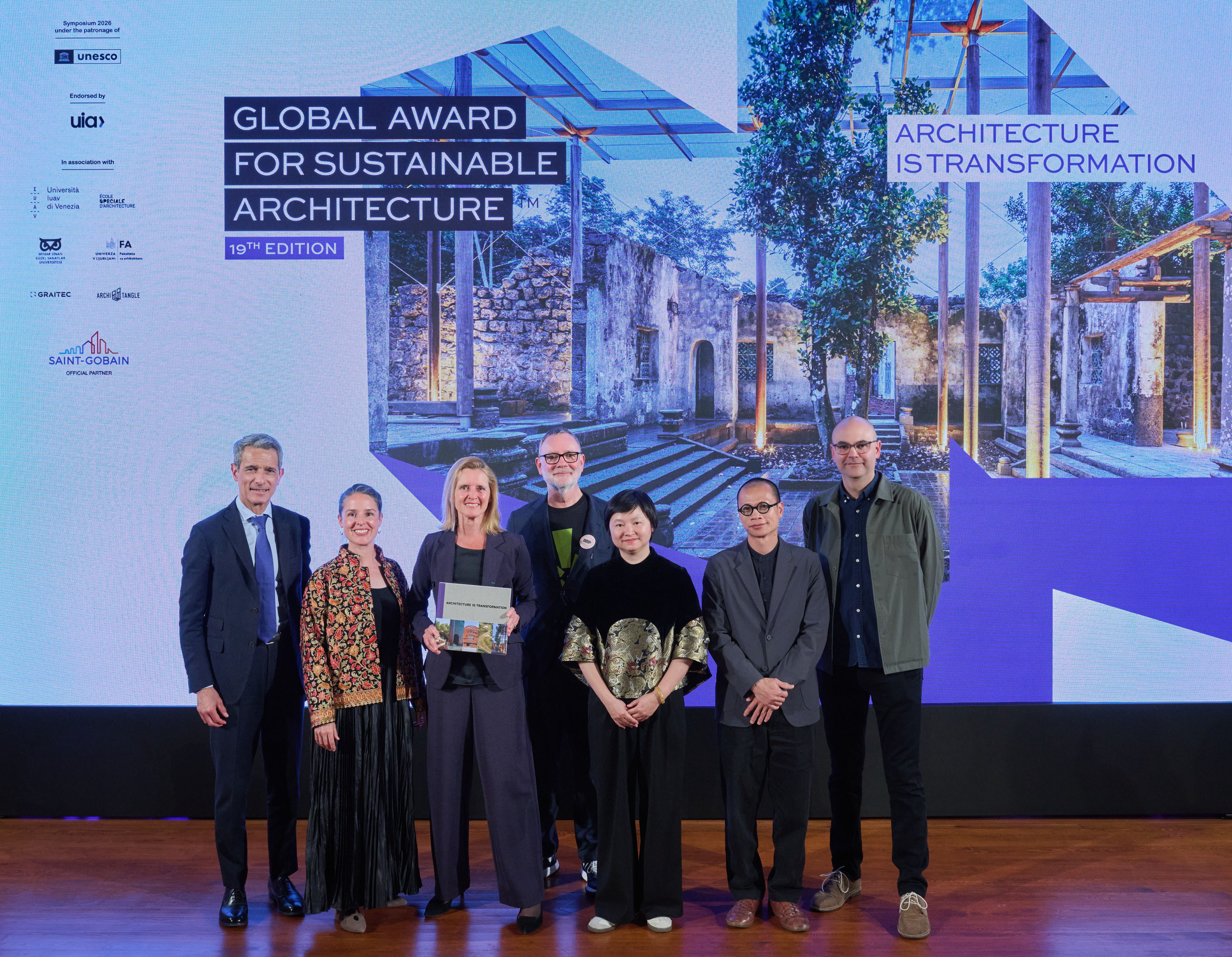
What if sustainable architecture represented a profound transformation in our way of living? The Global Award for Sustainable Architecture, whose 2026 edition has just taken place in Istanbul, rewards architects each year who are committed to innovative approaches to climate challenges. Under the patronage of UNESCO and the UIA (International Union of Architects), this award sheds light on the changes happening in architecture, redefining the real estate of the future.
Interview with Prof. Jana Revedin, its founder and president
The 2026 theme, "Architecture Is Transformation," suggests a profound change: what transformation are we talking about specifically today? Is it about buildings, uses, or the economic models of real estate?
The law of thermodynamics reminds us that no energy is created or lost; it only changes form. Today, we are called to transform an established system — one of an arrogant International Style guided solely by profit logic. Design processes, governance methods, and value systems are undergoing significant changes. "Architecture Is Transformation" is its clear expression: transformation occurs at all levels and scales. It ranges from reconfiguring territories, landscapes, and cities capable of absorbing and metabolizing past legacies to experimenting on a small scale with suspended lightweight structures made of wood and fibers, recycled glass and ceramics, or living walls composed of biopolymers.
Laureates come from very different contexts (China, Vietnam, Mexico, Europe): what is the major common point in their approach to social and environmental challenges?
Through the diversity of practices of our laureates, a constant remains: a deep, ethical, social, cultural, and political commitment. This position is not only aesthetic but programmatic — from the Bauhaus motto "less is more" to today's more pressing call: "better with less."
Do regulatory pressure and low-carbon goals accelerate transformation or hinder innovation?
Rules are necessary for society. But today, we are witnessing over-regulation in industrialized countries.
Sustainable development should in no way become a privilege reserved for the wealthiest countries. Political and cultural awareness is key, supported by smart — and measured — laws. Over the past thirty years, exemplary regions in federal contexts, such as Vorarlberg or Baden-Württemberg, have shown how an ecological construction culture can anchor itself territorially... and serve as a reference.
These contexts highlight what I call a "right-tech" approach: neither technophile excess — often prohibitively expensive — nor nostalgic regression. Vernacular innovation has never been about looking back but about mobilizing means tailored to location, climate, culture, and opportunities offered by local circular economies. In such frameworks, sustainability and renewed beauty arise from reengaging with archetypes, typologies, and practices deeply rooted in the materiality and history of places.
What does the partnership with Saint-Gobain represent for you, renewed for the third consecutive year? Can the collaboration between industry and architectural research accelerate the ecological transition?
It cannot only accelerate but must do so. At the Bauhaus, architects, craftsmen, designers, and industry worked together for architecture — and even a city — "accessible to all."
The Bauhaus brought about three profound changes in less than a decade. First, an ecological thought of the city: densifying existing areas, combining uses, integrating the living as a space for meeting and movement. Then, a material revolution: inventing healthy materials accessible to all. Finally, a project of emancipation and inclusion: since 1919, women could study architecture for the first time, while cultures from around the world came together.
These three principles — ecology, material innovation, inclusion — remain essential today. They notably underpin the research I conduct in our new research unit at the École Spéciale d'Architecture, focusing on "circularities": envisioning the city and architecture as a living, social, and innovative organism, driven by a keen awareness of economic circularity challenges.
Given climate challenges, what are the currently most used sustainable materials?
We must return to smart "right-tech" materials, designed and implemented with a very high quality requirement — and supported by modeling tools, robotization, and artificial intelligence. Bio- and geo-sourced materials from local resources: stone, ceramics, glass, wood, fibers, biopolymers — all potentially endlessly recyclable and long-standing in our millennia-old construction history.
What will an "exemplary" sustainable real estate project look like in 2035, and what will be the new criteria for virtuous projects?
The term "sustainability," stemming from 18th-century forestry — "not felling more trees than can grow back at the same time," according to Hans Carl von Carlowitz.
Beyond "sustainable": it's about designing architecture that ages well, plain and simple. How can this be achieved? By integrating — even better, by actively involving — residents and users, listening, patiently mapping the visible and invisible resources of a place.
Today, the paradigm shift is complete. Craftsmanship and industry are allies once again; the young generation of architects works in transdisciplinary teams, reinvents the existing with inventiveness, thinks about inclusion, and — an essential point — aims for true excellence in materiality and project.
Because what ties us to architecture, what makes us want to preserve and pass it on, lies in deeper qualities: atmosphere, memory, simple beauty. These qualities will ultimately enable architecture to age well. In 2035, these qualities will be paramount worldwide.
Since you created this award in 2006, what has surprised you the most in the evolution of sustainable architecture?
What surprised me the most since creating the award in 2006 is the evolution of my students. At the beginning of each workshop or seminar, I always ask them the same question: "What kind of architect will you be? An adjective, please."
In the 2000s, marked by the illusion of infinite growth, the answers were still: "unique," "famous," "influential." Today, they have changed. They answer me: "useful," "listening" — or simply "happy."
Will the 2027 announced theme mark an even more social turning point?
Oh yes, a theme both touching and urgent. After the essential transformation — rather than senseless waste — we are taking an additional step: for whom, essentially, do we design and build? The 2027 theme will be: Architecture Is Equity.
Global Award for sustainable Architecture