Bioclimatic houses on the Arcachon Basin: 2026 market overview
The Arcachon Basin has become one of the most active French territories in residential bioclimatic construction in recent years. With a temperate oceanic climate, a landscape of maritime pines conducive to architectural integration, an environmentally conscious CSP+ clientele, and strong urban planning constraints that emphasize quality, all the ingredients are combined to create a remarkable bioclimatic architectural scene. Here is a 2026 overview of the market, city by city and criterion by criterion.
Arcachon Climate Context
The Basin benefits from a mild oceanic climate, milder than the French average thanks to the thermal regulation of the maritime basin itself. Winters are moderate, summers pleasant with an Atlantic influence that limits extreme heat waves. This climatic mildness facilitates achieving high energy performance: heating needs are lower than in continental regions, and cooling needs remain manageable for well-designed constructions.
For a bioclimatic Arcachon house project, this favorable context translates into several coherent technical choices. The main southwest orientation, classic in oceanic areas, captures solar gains without excess. Generous windows can open without a major risk of summer overheating, provided they are protected by roof overhangs, pergolas, or suitable vegetation. Natural ventilation, exploiting the breezes from the basin, effectively complements the cooling needs. The principles generally align with those described in our passive house guide, with an adaptation to the oceanic climate.
Wooden Framework, Local Signature
The maritime pine from the Landes forest, bordering the Arcachon Basin, is a major asset for regional sustainable construction. Locally available in quantity, naturally treated with autoclave to withstand humid conditions, it provides excellent quality structural and cladding material with a reduced carbon footprint.
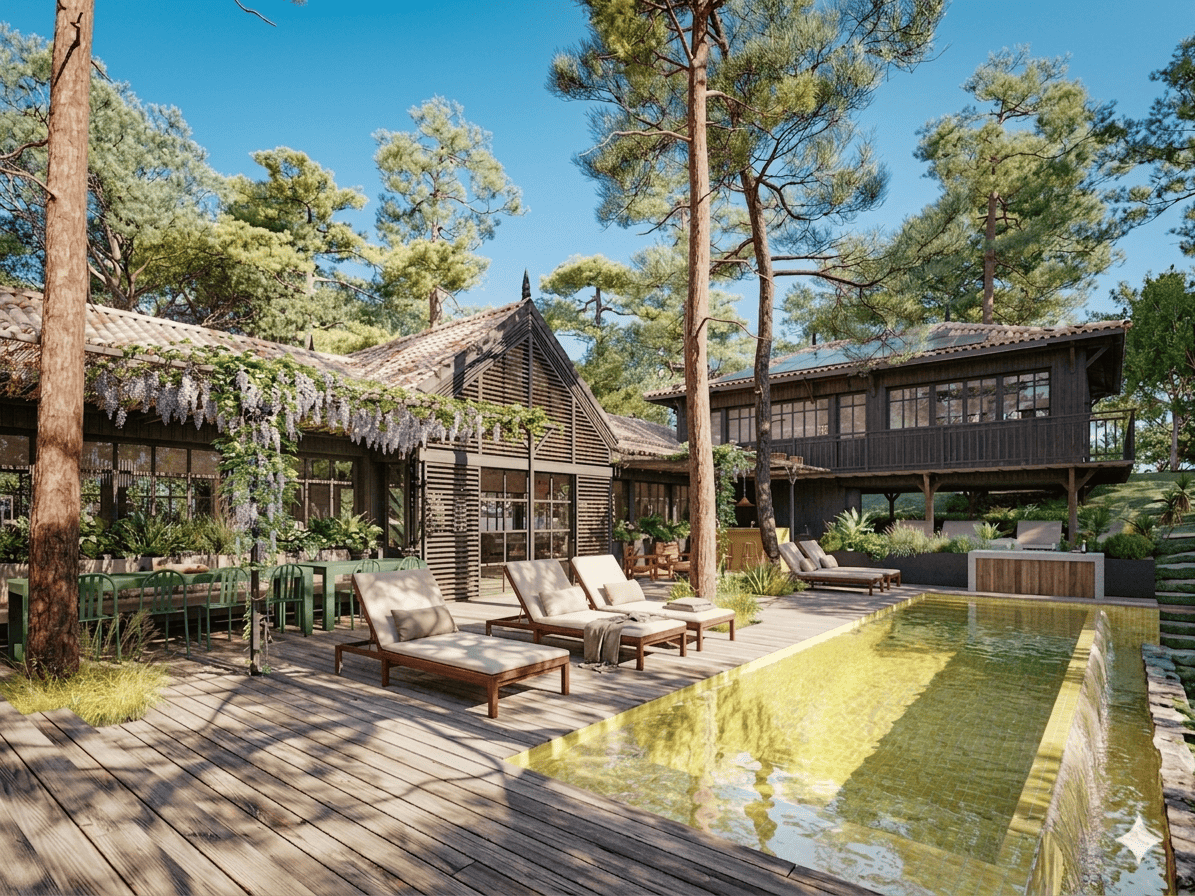
Wooden framework now dominates new bioclimatic constructions in Arcachon. Several structural advantages explain this choice: quick implementation, natural landscape integration, low carbon footprint, and compatibility with insulation in bio-sourced materials (wood fiber, cellulose wadding, straw for some exemplary operations) that are particularly efficient. The exterior cladding, generally in untreated local pine or simply oiled, takes on a characteristic silvery hue that harmonizes with the maritime pine environment.
Some recent operations reach the Passivhaus level or come close to it, with very low energy consumption validated by certification. The market remains confidential but steadily growing, driven by demanding demand and the presence of specialized architectural firms located in Cap Ferret, Arcachon, or Bordeaux.
Cap Ferret, Showcase of High-End Sustainable Construction
The Cap Ferret peninsula concentrates the most visible part of the premium bioclimatic offer of the Basin. The municipalities of Lège-Cap-Ferret, Le Canon, L'Herbe, or Les Jacquets have been hosting a new generation of new bioclimatic villas for about fifteen years, whose standards rival the best Mediterranean or Alpine achievements.
The entry ticket for a new bioclimatic villa of 180 to 250 m² in Cap Ferret ranges from 2 to 5 million euros depending on the location, with prices soaring beyond for properties on the first line of the basin. The services now systematically include sustainability standards: local wooden framework, bio-sourced insulation, electricity self-sufficiency through integrated solar panels, rainwater recovery, meticulous landscape integration with the preservation of existing maritime pines.
This clientele, mainly from Bordeaux and Paris but also international (Belgians, Luxembourgers, British), increasingly pays attention to the coherence between the villa and its environment. The contemporary Arcachon standard combines real energy performance, subtle landscape integration, and local materials - a triptych that now defines the high-end segment's identity of the Basin.
Pyla-sur-Mer and the South Coast, Heritage and Contemporary Segment
In the south of the Basin, Pyla-sur-Mer offers a mixed offer between restored historic villas and new bioclimatic constructions. The presence of the Dune du Pilat and the forest creates an exceptional landscape but is subject to strong urban planning constraints. Building in this area is strictly regulated by the Local Urban Plan, which maintains a certain scarcity of new properties and supports the value of existing ones.
New bioclimatic villas in Pyla are priced between 2.5 and 6 million euros for 180 to 300 m², with exceptional projects far exceeding these amounts. The restoration market is also active, with early 20th-century villas undergoing restoration with a high heritage and environmental requirement - breathable interior insulation, window replacements, discreet integration of rooftop solar panels.
For properties located in historically classified sites as Remarkable Heritage Sites, mechanisms like Loi Malraux can support restoration operations by funding part of the work through a substantial tax deduction.
Arès, Andernos, Lanton: More Accessible Northern Market
The northern basin offers a significantly more affordable alternative, with a steadily growing sustainable real estate market. Arès, Andernos-les-Bains, Lanton, and Audenge present new bioclimatic villas starting from 700,000 euros for 150 m², with technical standards comparable to Cap Ferret constructions but on less prestigious locations.
The interest in this segment goes beyond the purely financial argument. The immediate proximity to Bordeaux (35 to 50 minutes depending on the municipalities) makes it a relevant territory for year-round residents, telecommuters, or those in a hybrid mode. The local service fabric (schools, shops, cultural facilities) is dense and suitable for a permanent life, unlike more touristy municipalities. For families seeking a lifestyle coherent with sustainability without the prohibitive entry ticket of the southern Basin, this is likely the most relevant segment.
Technical Points to Check in an Arcachon Project
For a bioclimatic house purchase project on the Basin, several specific checks are necessary beyond the Energy Performance Diagnosis (DPE).
The orientation and solar protections must be adapted to the oceanic climate. Southwest orientation, with windows protected by roof overhangs or pergolas, captures solar gains without a major risk of overheating. External shutters - louvered or sliding - remain essential, particularly for west-facing properties exposed to the late afternoon sun in summer.
Insulation should favor breathable materials, suitable for the constant atmospheric humidity of the Basin. Wood fiber, cellulose wadding, hemp wool are preferable to synthetic airtight insulators that may cause disorders in the long term. Careful airtightness, validated by an airtightness test, completes the system. The EnerPHit standard in renovation, detailed in our passive house guide, sets a reference for the most demanding operations.
The heating system should be sized for relatively modest needs, as the oceanic climate limits peak demand. The air-water heat pump is the dominant solution in the Basin, with satisfactory performance even during the harshest winters. Solar thermal for domestic hot water production beneficially complements the system. For properties not served by gas, a pellet boiler could be considered for seasonal or permanent use.
Water self-sufficiency and management of rainwater take on a particular dimension in this territory. Rainwater recovery for watering and toilet flushing is now an expected standard in high-end properties. Efficient individual sanitation, when the property is not connected to the collective network, is a major qualifying criterion given the ecological sensitivity of the Basin.
Fiscal and Applicable Aids
The eco-PTZ finances up to 50,000 euros for energy renovation works on an existing property, which can be combined with MaPrimeRénov' depending on household resources. For rental investors, the Jeanbrun system applies on the Arcachon Basin without geographical constraint, with a fiscal depreciation that can reach 80% of the housing value over nine years. Additionally, the Nouvelle-Aquitaine region offers several programs for energy renovation and sustainable self-construction, which can be explored through the regional ADEME or municipal urban planning services.
Where to Look for a Bioclimatic House on the Basin
Sustainable Real Estate references bioclimatic houses across the entire Arcachon Basin, from premium Cap Ferret to more accessible northern municipalities. The Arcachon Basin page gathers the regional selection, filterable by location, sustainable criteria, and property type.
For exceptional heritage properties - restored Arcachon villas, properties on the basin edge, converted oyster huts - the Heritage section extends the selection with a reinforced heritage dimension. Buyers sensitive to architectural aspects can also enhance their search by browsing the complete selection on Sustainable Real Estate, covering all available typologies.
Sustainable Real Estate selects properties with very high energy performance throughout France. Discover the Arcachon selection on theArcachon Basin page and the7 sustainable criteria applied to each property.