Buying a bioclimatic house in Provence in 2026
Before the term even existed, Provence was already building them. Local builders did not wait for contemporary science to orient their houses to the south, thicken their stone walls, shade their terraces, and use the Mistral wind for ventilation. What research now validates as bioclimatism, the region has been practicing for centuries through simple climate observation. A new generation of local architects and builders is reinterpreting this vocabulary with current techniques, and the Provencal market is now organized around properties that deserve close examination.
What truly deserves the bioclimatic label
The term is used a little too easily, especially in real estate listings. Not all new Provencal houses are bioclimatic, far from it.
A true bioclimatic house leverages the resources of the location to reduce its active energy needs. In Provence, this is recognized by specific markers: living rooms oriented south to southeast with windows protected by sunshades or pergolas calculated according to the sun's path, cross ventilation that harnesses the Mistral wind, walls with high thermal inertia. Biosourced materials - wood fiber, hemp, cellulose wadding - replace petro-sourced insulators that are ill-suited to the humid Mediterranean climate.
The overall design carries more weight than the sum of the equipment added afterwards. A house designed for the climate in Lille will not necessarily be bioclimatic when transplanted to Provence: the theoretical diagnosis may show excellent numbers, but summer comfort could turn out disastrous. It is this nuance that educated buyers learn to identify.
The Luberon, premium market and international clientele
The Luberon concentrates the most visible part of the high-end bioclimatic offering in Provence. The towns of Gordes, Ménerbes, Bonnieux, Lourmarin, or Cucuron have long attracted an international clientele particularly attentive to sustainability standards. The market there is structured around several distinct segments.
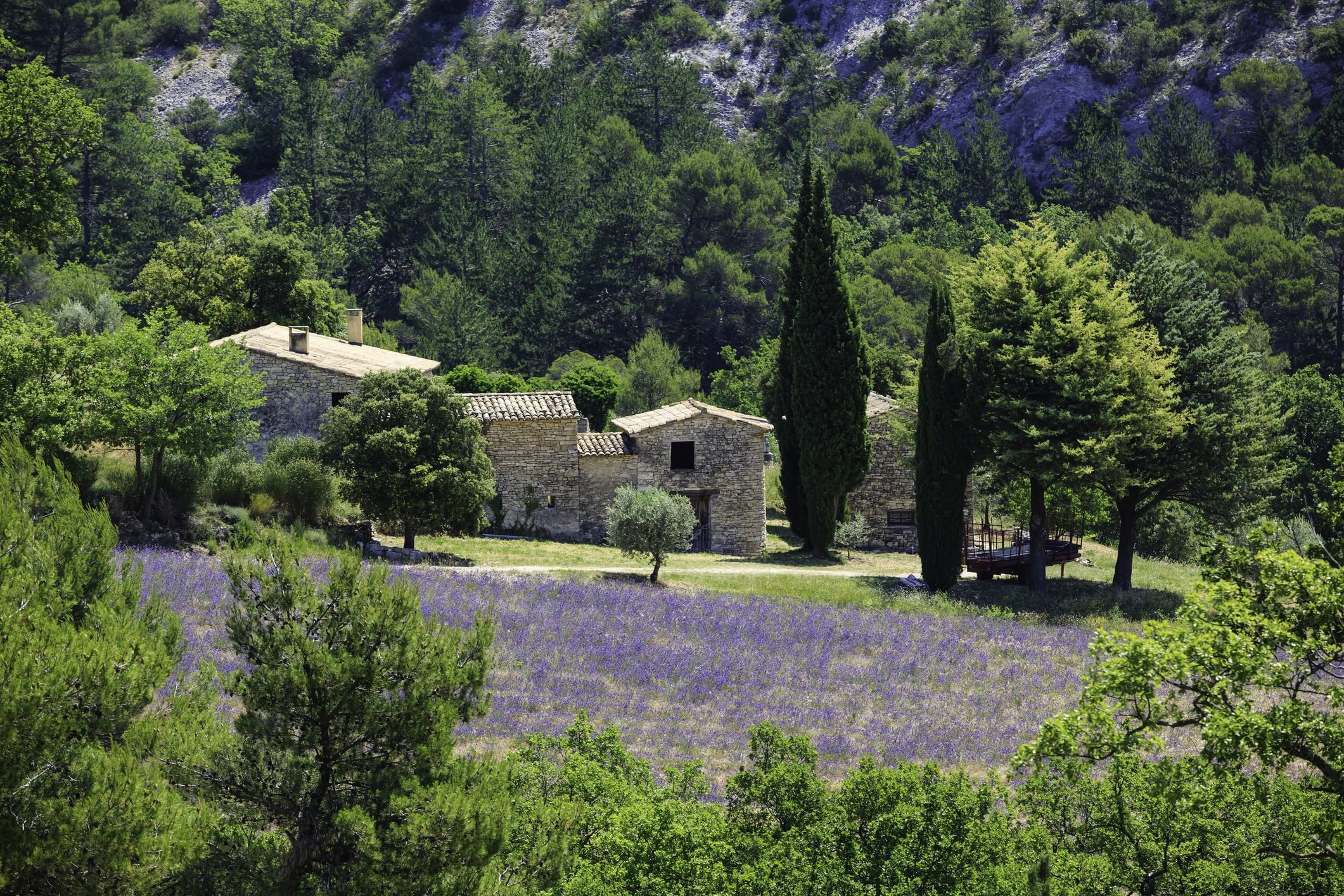
The restored mas following a bioclimatic logic constitutes the historical heart of the offer. Limestone, wooden framework, lime plasters, preserved cross ventilation, added breathable insulation: these demanding restorations are negotiated between 1.5 and 5 million euros for properties of 200 to 400 m² on generous plots. This segment best fits the imagination of the Luberon.
Alongside the restored heritage, new contemporary villas are emerging. Designed by local or international architects, they reinterpret the Provencal vocabulary with current techniques - inertia maintained by masonry walls, glass windows with properly sized sunshades, integrated solar panels on the roof. Typical range: 1.2 to 3 million euros for equivalent surfaces to the preceding segment. Some operations now reach the Passivhaus or EnerPHit level in renovation, the principles of which are detailed in our complete guide to passive houses.
Water self-sufficiency has become a separate negotiation point in this territory. The recurrent summer restrictions of recent years have convinced buyers that a close look was necessary. Rainwater collection tanks, declared boreholes, water-efficient irrigation for gardens: these facilities are shifting from accessory status to a central criterion.
The Alpilles, generous lands and sleek architecture
The Alpilles massif offers a more open aspect than the Luberon, and often a more contemporary architecture. Saint-Rémy-de-Provence, Maussane-les-Alpilles, Eygalières, and Mouriès host a concentration of new bioclimatic villas on plots of 3,000 to 10,000 m². Prices range from 900,000€ to 2.8 million euros for surfaces of 180 to 350 m², in a market slightly less tense than the Luberon - which sometimes allows for more negotiation margin.
The architecture embraces exposed stone and simple volumes, with large southern windows and careful sun protection. Several recent villas integrate solar panels and a partial electric self-sufficiency. The dominant buyer profile: an urban retiree or a fifty-something CSP+ individual looking for an autonomous house for the next twenty years.
The Aix region, city-countryside transition
Between the rural dimension of the Luberon and the urban Aix-en-Provence market, the Aix region occupies an intermediary position that appeals to a particular clientele. The towns of Tholonet, Beaurecueil, Saint-Marc-Jaumegarde, or Puyricard have been hosting a new generation of bioclimatic villas for about a decade, intended for Aix executives or urban retirees. Entry prices generally range from 800,000€ to 2 million euros for surfaces of 150 to 280 m².
The sector's appeal lies in a rare balance. It offers access to the urban amenities of Aix-en-Provence - high schools, hospitals, TGV station, cultural life - while benefiting from a more natural environment and plots allowing for a genuine bioclimatic approach. For buyers who do not want to completely isolate themselves, it is often the best geographical compromise in the region.
The inland Var, still a confidential alternative
Further to the east, the inland Var mostly remains under the radar of international buyers, and that is precisely what makes it interesting. Villages like Cotignac, Tourtour, Salernes, or Aups offer a preserved rural setting, generous plots, and significantly more accessible prices. A new bioclimatic villa of 200 m² can be found from 600,000€, sometimes less, on plots that often exceed 5,000 m².
The obvious drawback is the distance. It takes an hour and a half to two hours from Marseille or Aix-en-Provence, which is viable for a remote worker or mobile retiree but becomes prohibitive for a professional moving daily. A generation of local builders is emerging there, trained in contemporary standards while remaining anchored in the Provencal tradition. Their projects deserve special attention from buyers who accept this geographical compromise.
Checkpoints before purchase
Beyond the Energy Performance Certificate, several elements must be examined before committing to a Provencal house presented as bioclimatic.
Orientation and sun protection are the first points to consider. Living rooms facing south or southeast, glass windows protected by external devices sized for summer sun - sunshades, pergolas, brise-soleil. If the only protections are internal shutters, the bioclimatic design is inadequate regardless of the theoretical quality of the EPC.
The thermal inertia of the walls is the second decisive criterion. A 40 cm stone wall offers thermal behavior incomparable to a 20 cm cinder block doubled with thin insulation. In a Mediterranean climate, it is inertia that protects against the summer thermal shock, more than the insulation thickness.
The nature of the insulating materials used matters as much as their thickness. Biosourced materials - wood fiber, hemp, cellulose wadding - are more breathable and better suited to the humid Mediterranean climate than polystyrene or mineral wool. This breathing of the walls prevents disorders related to humidity, particularly sensitive with old stone buildings.
Ventilation and cooling deserve specific attention. Natural cross ventilation, harnessing dominant winds, remains the most elegant solution in Provence. Otherwise, a efficient double-flow VMC, correctly sized and maintained, does the job. Regarding air conditioning, its presence is not prohibitive per se: it should be used as a supplement during heatwaves, not as the main system. A true bioclimatic house goes without air conditioning 95% of the time. If it runs continuously, there is a bioclimatic design flaw somewhere.
Water self-sufficiency now stands as a central criterion. Rainwater recovery tank, declared borehole, water-efficient garden irrigation. On a Provencal plot, these facilities are no longer just ecological comforts but practical resilience against increasing summer restrictions. A landscaped garden with dry Mediterranean species - olive trees, lavender, rosemary - coherent with the bioclimatic approach is always better than a continuously watered lawn.
Taxation and applicable aids
Several measures can support the purchase or renovation of a bioclimatic house in Provence. The Eco-friendly Loan (<Éco-PTZ>) finances up to 50,000 euros of energy renovation work on an existing property, combinable with MaPrimeRénov' depending on the household's resources and the type of work.
For rental investors, the Jeanbrun scheme provides a fiscal amortization of up to 80% of the property value over nine years, applicable to both new and old properties, without geographical limit. It is a tool particularly suitable for new bioclimatic villas intended for unfurnished rental.
For properties located in classified historical centers - Aix-en-Provence, Avignon, Arles, Salon-de-Provence, Tarascon - the Malraux Law remains one of the most powerful tax incentives to finance demanding heritage restoration. Eligibility depends on the exact perimeter (PSMV or PVAP), to be verified with the town's urban planning services. Local aids - solar panels, water recovery, solar water heaters - vary from one local authority to another. Prior information from the regional ADEME or local urban planning department is always useful before starting a project.
Where to look for a bioclimatic house in Provence
Sustainable Real Estate features bioclimatic houses throughout Provence, from restored mas in the Luberon to contemporary villas in the Alpilles or Aix region. The Provence page gathers the regional selection, filterable by location, sustainable criterion, and property type. For exceptional heritage properties, the Heritage section extends the selection with the region's most emblematic rural properties.
Sustainable Real Estate selects very high-energy performance properties throughout Provence. Discover the selection on theProvence page and the7 sustainable criteria applied to each property.