Passive House in France: Complete Guide 2026
The passive house has become one of the most demanding standards in sustainable real estate in just a few years. Stemming from a German protocol developed in the 1990s, it is now recognized as a benchmark for buyers looking to combine quality of life, energy independence, and long-term asset value. This guide examines what a passive house really is, how much it costs, and where to find one in France in 2026.
What is a Passive House?
A passive house is a building designed to minimize the need for heating and cooling to the extent that it can almost do without them. The term comes from the German label Passivhaus, created in 1991 by physicist Wolfgang Feist. For a building to be Passivhaus certified, it must meet three measurable criteria:
- Primary energy consumption for heating must be less than 15 kWh/m²/year
- Air tightness measured at n50 ≤ 0.6 air changes per hour
- Total primary energy consumption (heating, hot water, electricity) must be less than 120 kWh/m²/year
For comparison, a property classified as DPE A consumes less than 70 kWh/m²/year in primary energy. A passive house represents an even higher level of performance, especially applicable to new constructions or major renovations.
Technical Principles of a Passive House
A passive house is not based on a single miraculous equipment but on a combination of five principles:
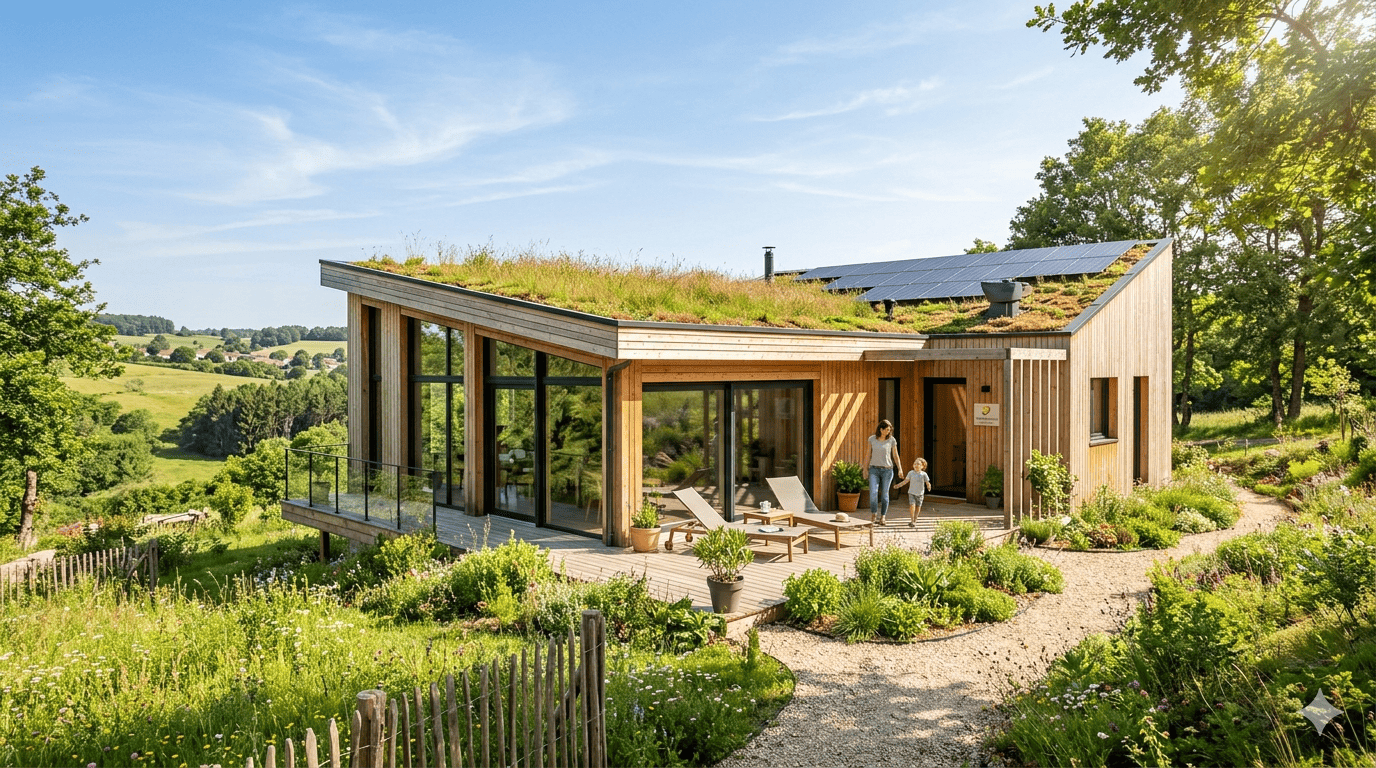
Enhanced insulation. The walls, roof, and floor benefit from insulation two to three times thicker than in a conventional construction. Biobased materials such as wood, straw, hemp, or cellulose wadding are favored for their reduced carbon footprint.<;>Air tightness. All junctions between materials are treated to avoid air leaks. A mandatory blower door test validates the performance.<;>Double-flow mechanical ventilation with heat recovery. Stale air is extracted and preheats incoming air. The system recovers up to 90% of the heat, allowing the house to be heated almost exclusively by solar and internal gains (occupants, appliances).
<;>Bioclimatic orientation. The glass windows are mostly oriented to the south to capture solar radiation in winter, with protections (caps, sunscreens) to prevent summer overheating.<;>Efficient triple-glazed windows with a Uw coefficient below 0.8 W/m².K.How Much Does a Passive House Cost in 2026?
The cost of a passive house in France in 2026 ranges from €2,200 to €3,200 per square meter for new construction, representing a surcharge of about 10 to 20% compared to a construction compliant with RE 2020. This surcharge is offset over the building's lifespan by energy savings: a passive house consumes on average 90% less heating than a standard house built before 2005.
Several aids can reduce the initial investment: eco-PTZ up to €50,000, MaPrimeRénov' for renovations, local schemes according to regions. For a buyer, the asset value is also preserved: as the DPE tightening schedule progresses (rental prohibition for G-rated properties in 2025, F in 2028, E in 2034), high-energy performance properties increase in attractiveness.
What's the Difference Between a Bioclimatic or BBC House?
Three standards are often confused but correspond to different levels.
A bioclimatic house optimizes its relationship with the sun, wind, and vegetation to reduce energy needs. It is an architectural approach, not a certification. It can achieve good performance without necessarily obtaining the Passivhaus label.
A BBC house (Low Consumption Building) complies with the French label created in 2007, now integrated into current standards. Its maximum heating consumption is about 50 kWh/m²/year – three times more than a passive house.
A passive house achieves the most demanding performance level of the three, with an international certification issued by the Passivhaus Institut.
The three approaches are complementary. A passive house is generally also bioclimatic in its design and exceeds BBC requirements. The properties listed on Sustainable Real Estate cover these three levels according to the sustainable criteria identified by the "Energy Efficiency" label.
Where to Find Passive Houses in France?
Passive houses are still in the minority in France compared to Germany or Austria, but their number is growing rapidly. Several regions focus on projects: Alsace for historical reasons (German proximity), Brittany and the Atlantic coast for their favorable temperate climate, and rural areas suitable for new bioclimatic constructions.
Sustainable Real Estate lists high-energy performance properties, including certified passive houses, throughout France. The properties can be filtered by sustainable criteria, including energy efficiency. The selection includes both recent new constructions and exemplary renovations of old buildings, as found in the Heritage section.
Sustainable Real Estate only lists properties classified as DPE A, B, or C. Discover over 15,000 eco-responsible properties selected according to 7 sustainable criteria.