
Amelia Tavella: "A sustainable building is a building that one does not want to destroy"
There are architects who build. And then there are architects who listen first.
Amelia Tavella belongs to the second category. Before placing anything, she examines. She reads a site like one reads a soil, searches for layers, traces, what has lived there before. Only then does the project begin.
The jury of the Global Award for Sustainable Architecture 2026 rewarded her for exactly that: an architecture they described as "emotional, sensual, and organic," capable of reconciling heritage and sustainability without brutalizing either. The theme of this edition was "Architecture Is Transformation." It's hard to find a more fitting laureate.
We interviewed her.
What does transformation mean in your practice?
I come from a territory where one learns very early that the landscape is older than us. The Mediterranean is my matrix. Corsica taught me about light, slopes, materials—but also the idea that no creation makes sense without ethics.
Transforming is first and foremost about listening. Observing a place, x-raying it, almost digging through it like an archaeologist before any intervention. Reading the layers, the traces, the memories. I look at buildings as living beings. They have a history, sometimes scars, a human and territorial thickness. Building is not about erasing that, but about continuing a story. Building without destroying. Inventing without denying.
The theme "Architecture Is Transformation" resonates deeply with my practice because it re-establishes architecture in an idea of responsibility. Today, we talk a lot about sustainability, but sustainability cannot be purely technical. I deeply believe that a sustainable building is a building that one does not want to destroy. A building that belongs to its territory to the point of becoming self-evident.
Your work is often described as an architecture that "reveals" rather than transforms. Is interpreting the existing foremost for you?
Yes, absolutely. I believe that a place already possesses an intelligence. A light, a geography, a material, sometimes even an invisible memory. Architecture should dialog with that rather than deny it.
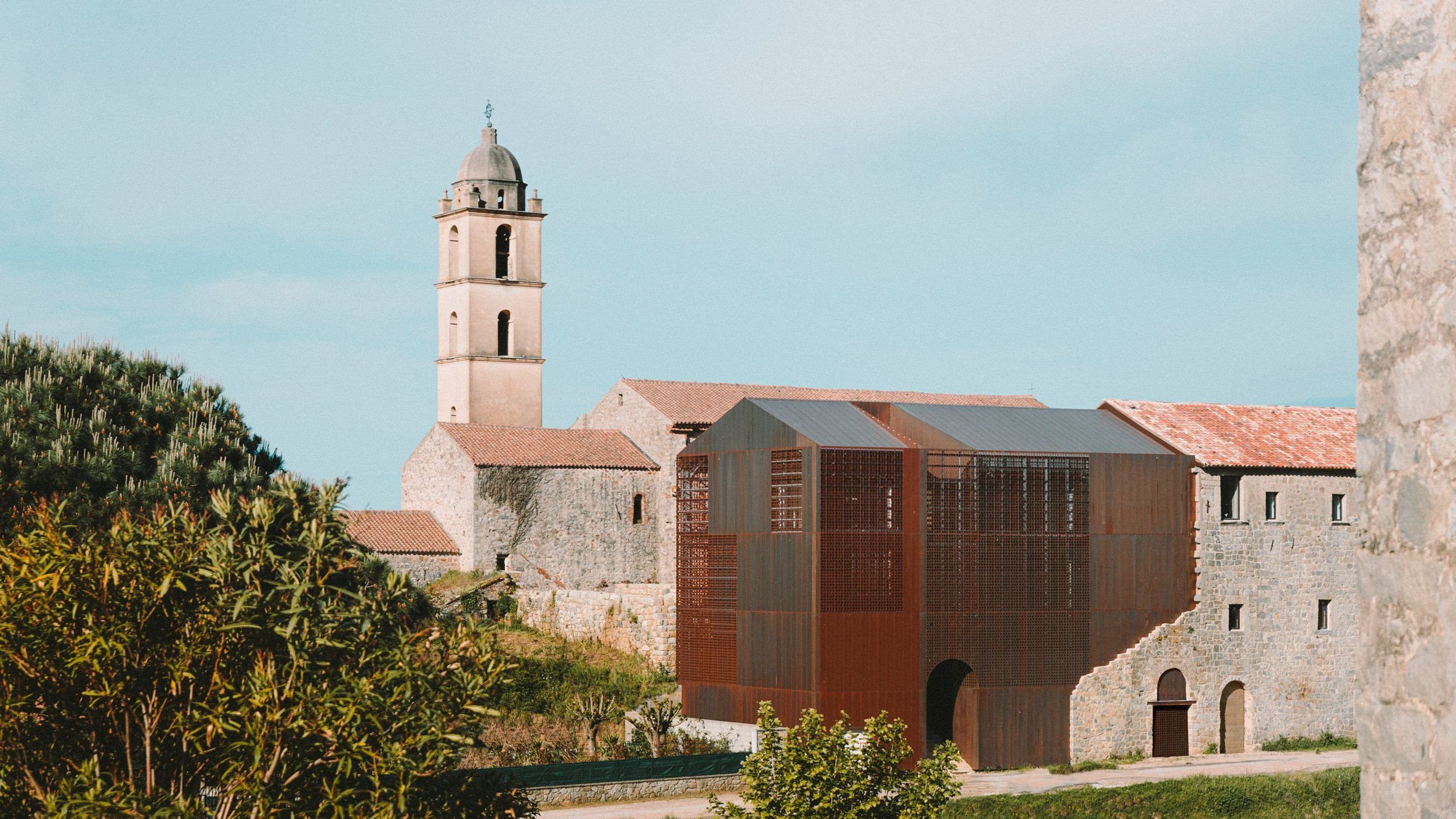
Interpreting the existing does not mean being nostalgic. On the contrary, it requires a lot of invention and delicacy. I never seek to reproduce the past. I aim to extend a presence, to make the layers of time converse without opposing them. As I wrote about the Couvent Saint-François: "to build from the ruins is the past and modernity embracing each other, making a promise to never betray each other."
The building already existed like an unfinished memory, almost like a wounded body. I didn't want to erase the ruin but to reveal its silent strength. The copper did not come to cover the stone; it came to extend its breath, transmit its lost form, bring forth a second skin between disappearance and rebirth.
On territories and what we do to them
How can your vision address the current challenges of transforming territories?
For a long time, territories were thought of through logics of speed, productivity, and expansion. Sometimes we built architectures that were disconnected from their geography, climate, human memory. Today, we understand that places need long time.
Reconciling space and time is precisely refusing a detached architecture. It is considering that a building belongs to a landscape, a culture, uses, a collective history. A territory is never a blank page.
Each place already possesses an intelligence, a memory, a way of inhabiting that must be listened to before intervening. This is particularly true in rehabilitation projects, where architecture can be an act of continuity rather than one of erasure. In the Couvent Saint-François, it was not about rebuilding a static monument, but about extending a presence—allowing a ruin, a landscape, and a contemporary use to coexist in the same temporality.
Can architecture influence the social and economic dynamics of a territory?
Yes, deeply. Architecture is never just an aesthetic object. It influences how people live, meet, work, move, look at their territory.
A project can restore dignity to a forgotten place. In Lumio, in Cabriès, or at A Strega, the schools we designed are not just considered as facilities. They become places of transmission, spaces where children learn as much from the presence of the landscape, light, and materials as from the teaching itself.
At Château de Nalys, we used materials from the site itself and regional quarries, so the building literally extends the geology and memory of the place. Short circuits, local resources, artisans—this is an integral part of the thinking. It's not just an environmental issue. It's a way to preserve a human economy and a cultural continuity.
But what matters most to me is that architecture can reintroduce emotion into territories. And this emotion creates attachment. A territory to which one is attached is a territory that will be protected even more.
On materials and the intuition of the territory
You often mention "the intuition of the territory." How does an engaged act influence the sustainability of a project?
I believe that sustainability starts long before the technical aspects. It starts in how a project looks at a territory.
An engaged act is first about listening to what is already there: geography, light, climate, a constructive culture, know-how, human memory. Stone, wood, copper, water are never just decorative choices in my work. They are languages.
As for technological innovation, I never see it as an end in itself. It becomes interesting when it remains in service of the sensitive, the living, and the long term. The copper of the Couvent Saint-François is an example: the technology enabled the creation of a precise and reversible contemporary structure, but this innovation remains invisible as a demonstration. It acts as a second skin that dialogues with the stone and accompanies the transformation of the place without brutalizing it.
In the end, building with accuracy may be the most sustainable form of modernity.
On rehabilitation and what real estate is still missing
How does rehabilitation enable building without erasing?
To rehabilitate is to accept that a place has already lived before us. I find this idea very beautiful.
For a long time, architecture was built on the idea of a blank slate, as if we had to erase to create. Today, we understand that buildings, landscapes, and territories carry a human, cultural, and even emotional memory that must be preserved. I never consider heritage as something static. I believe in its living continuity.
The Couvent Saint-François embodied this reflection. The building was partially in ruins, dormant for decades. I didn't want to rebuild against the vestiges but with them. The copper came to extend the stone like a delicate graft—a second skin capable of transmitting the lost form without erasing the traces of time. I've always seen this project as a meeting between the past and modernity, promising not to betray each other.
Is reusing and transforming existing buildings currently underestimated by real estate actors?
Yes, and this awareness is progressing, but still insufficient.
For a long time, existing buildings have been seen as a constraint: more complex, slower, sometimes less profitable in the short term than new construction. Yet, I believe exactly the opposite. The existing represents an immense resource for the future. Destroying them systematically to rebuild often means erasing an intelligence already present in the territory.
I deeply believe that the city of tomorrow will be built more through transformation than expansion. Rehabilitating a building is not just about preserving a facade. It's about extending a story, reactivating uses, avoiding significant material and energy expenditure, but also maintaining an emotional bond between a place and those who inhabit it.
Real estate actors are beginning to understand that the value of a project no longer lies solely in its immediate profitability but also in its ability to create attachment, sustainability, and a strong identity. A building to which people are attached is a building that is maintained, that is passed down, that is not wanted to be destroyed. Perhaps this is the most accurate definition of a sustainable architecture.
On Corsica and ethics as a foundation
"There is no valid creation without ethics." How does your relationship with Corsica structure your way of conceiving?
Corsica is my matrix. It shaped my perspective long before I became an architect.
I grew up with a very instinctive relationship with the landscape: the light, the rock, the scents of the maquis were part of my daily life. Very early on, I understood that nature was not just a backdrop but a presence. Corsica taught me humility. You do not dominate such a landscape; you learn to live with it. The slope taught me to accompany rather than impose.
I believe that it is from there that this conviction was born that there is no valid creation without ethics. Because a territory always precedes us. We are merely inscribing ourselves in a broader history.
The island holds layers of memory, of silence, of resistance within it. This depth inhabits all my projects, even when they are geographically distant. I deeply believe that building is not about taking possession of a territory. It is about engaging in a dialogue with it.
After this international recognition, what types of projects do you wish to develop?
This recognition accompanies my desire to move towards a new territory of exploration.
For a long time, Corsica was my sensitive laboratory. It built me, rooted me, structured me. Then I had to leave it, as one leaves a family to grow. Today, I feel the desire to continue this emancipation. To embark on a quest for new horizons, sometimes far away. To discover other landscapes, climates, constructive cultures.
I am deeply touched by vernacular architectures because they always tell a way of living with a territory. Every civilization holds a sensitive intelligence of the world, and architecture is often its most profound trace.
What interests me is not to reproduce a formal design from one place to another, but to continue to learn. To listen. To move internally as well. I would like to develop projects where architecture creates a dialogue between cultures, between memory and contemporaneity, between territories and future uses.
In essence, I am simply continuing the same research: understanding how to inhabit the world with more attention, more humility, and more poetry.