Biosourced materials: choosing wood, hemp, straw, or cork for a sustainable project
The subject of biosourced materials has moved beyond insiders' circles in recent years to become a central topic in all discussions on sustainable construction and renovation. Mandated by RE 2020, endorsed by environmental certifications, favored by a new generation of buyers concerned about buildings' carbon footprint: these biologically sourced materials are now an essential dimension of sustainable real estate projects. However, their diversity, specific performances, and implementation constraints require a thorough understanding before any choice. Here is a comprehensive guide to navigate through them in 2026.
What exactly are biosourced materials
A biosourced material is a construction material derived from biomass - plant or animal origin - usable in building construction or renovation. This broad definition covers a wide variety of materials and uses: primarily thermal insulation but also structure, finishes, coatings, and paints. The common characteristic is the renewable origin of the material, as opposed to petrosourced materials (polystyrene, polyurethane) or energy-intensive mineral materials to manufacture (glass wool, rock wool).
The environmental benefits of biosourced materials rely on two complementary mechanisms. Firstly, they store carbon throughout their lifespan in the building - approximately 900 kg of CO2 equivalent is sequestered by one cubic meter of wood. Secondly, their production requires less energy compared to synthetic or mineral insulators, significantly reducing their overall carbon footprint. This aspect is now explicitly valued by RE 2020, which incorporates a carbon indicator across the building's entire life cycle.
Beyond carbon footprint, biosourced materials offer intrinsic technical qualities particularly suited to sustainable buildings - especially their ability to regulate humidity through air exchange, a valuable feature in old stone buildings or humid climates.
Wood, a central material in sustainable construction
Wood is the most widely used biosourced material in sustainable construction, both in structure and insulation. Several species and formats coexist depending on the uses.
For the structure, glued-laminated timber or solid wood are dominant solutions in contemporary timber frame constructions. Resinous species - spruce, fir, Douglas fir, larch - dominate the market for their cost-effectiveness and availability in France. Maritime pine from the Landes forest is particularly used in the southwest, notably in constructions around Bassin d'Arcachon. Larch, due to its natural resistance, is used in many Alpine claddings. Corsican chestnut regains its place in island construction, as discussed in our guide on ecological construction in Corsica.
For thermal insulation, wood fiber is the most versatile biosourced insulant. Available in rigid boards, semi-rigid boards, or loose-fill, it offers a thermal conductivity comparable to mineral wool (lambda around 0.038 to 0.045 W/m.K) while exhibiting much better thermal inertia - a decisive property for summer comfort. Dense wood fiber panels are particularly suitable for external insulation of masonry walls, while semi-rigid panels are used for insulation in attics or timber frame walls. Indicative cost: 25 to 45 €/m² depending on thickness, installed.
Hemp, versatile and high-performing
Hemp is one of the most versatile biosourced materials available today. The French hemp construction sector has experienced significant growth since 2010, with several processing units scattered across the country ensuring supply security and cost control.
Thermal insulation by hemp wool, available in rolls or panels, offers performance comparable to wood fiber with slightly higher weight. Its excellent resistance to insects and humidity makes it an especially interesting choice for humid climates or old buildings. Indicative cost: 30 to 50 €/m² installed.
Hempcrete, a mixture of hemp shives (woody part of the stem) and lime, constitutes a combined structural and insulating solution. Applied by shuttering or spraying, it fulfills both the insulating and inertial thermal mass functions. This technique particularly appeals to projects for respectful renovation of old stone buildings, where breathability and humidity regulation are essential. Renovation projects of Haussmannian Parisian apartments frequently use this technique to preserve the integrity of the stone walls while significantly improving thermal performances.
Straw, a confidential material with great potential
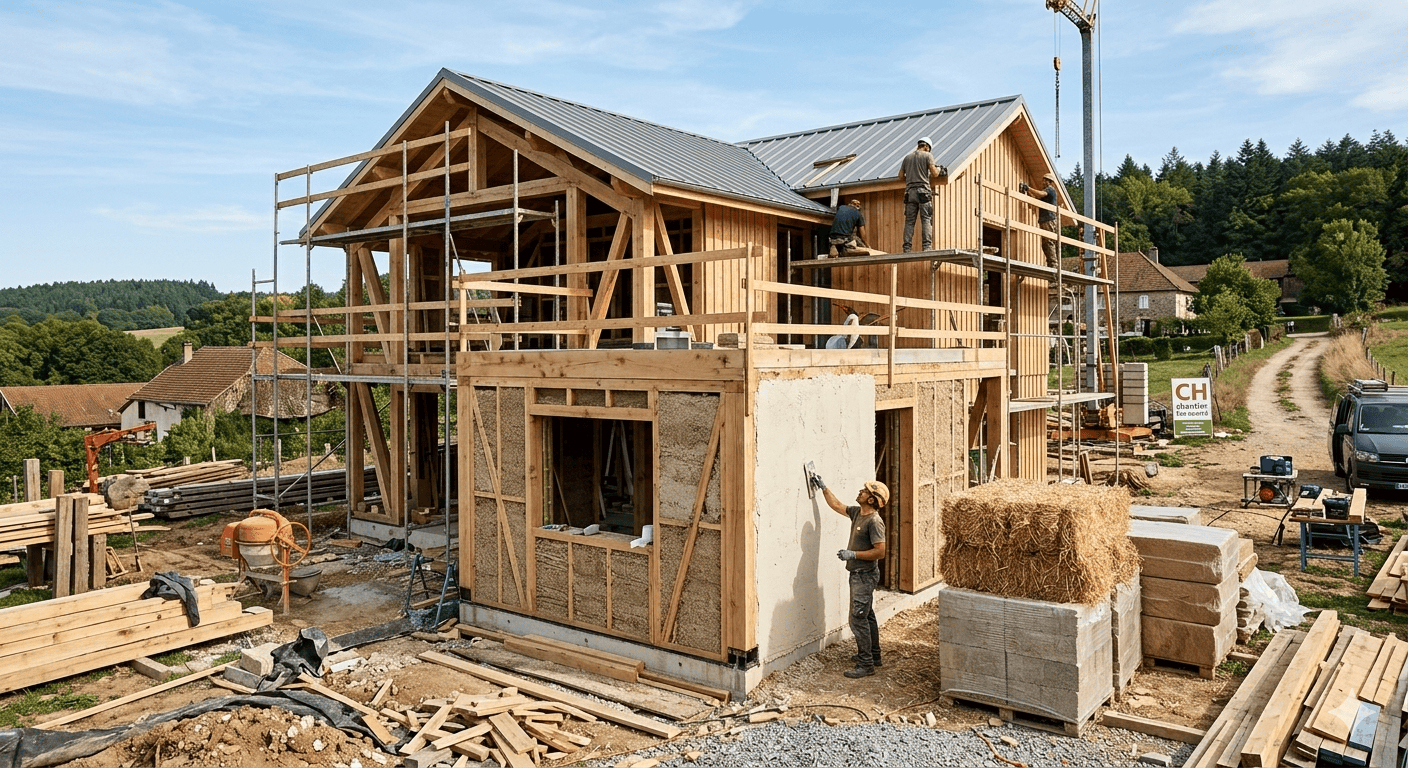
Straw as an insulating material remains a minority in France but is steadily progressing, driven by specialized actors and a new generation of builders. The technique involves using compressed straw bales integrated into a timber frame, covered with lime or earthen plasters.
The thermal performances of straw are remarkable: lambda around 0.055 to 0.080 W/m.K depending on density and fiber orientation, slightly lower than mineral wool but largely compensated by the typical thickness of a bale (37 or 47 cm), resulting in exceptional overall thermal resistance. Straw construction easily achieves the Passivhaus level, as detailed in our guide to passive houses.
The cost of a straw construction is generally comparable, if not lower, than that of an equivalent conventional construction when partial self-construction is considered. When entrusted to a specialized company, the cost aligns today with that of traditional biosourced construction, around €1,800 to €2,500 per square meter for all trades.
Cork, specialist in Mediterranean climates
Cork is extracted from the bark of cork oak, mainly cultivated in the south of France (Var, Aude, Corsica) and Portugal. Its closed cellular structure gives it exceptional thermal and acoustic insulation qualities, combined with remarkable natural resistance to humidity, insects, and mold.
Expanded cork, sold in panels of different densities, is a particularly suitable insulant for humid Mediterranean climates. Its resistance to humidity makes it a preferred choice for insulating foundations, low floors, and damp rooms. When used for external insulation under cladding, it offers excellent thermal inertia and valuable humidity regulation for Mediterranean constructions - a dimension often discussed in our analysis of sustainable Mediterranean real estate.
The cost of cork is significantly higher than other biosourced materials (€60 to €100 per square meter installed depending on thickness), but its exceptional durability - several centuries - and specific qualities justify this investment for demanding projects.
Cellulose wadding, recycling and performance
Cellulose wadding, made from recycled newspaper, is one of the most economical biosourced insulants available in France today. Several French factories produce this material, ensuring broad availability and competitive cost.
Its thermal performances are excellent (lambda around 0.038 to 0.042 W/m.K) with particularly effective implementation by blowing in attics or insufflation in timber frame walls. Its greater density compared to synthetic insulants also gives it good thermal inertia and excellent summer comfort. Indicative cost: €20 to €35 per square meter blown, making it one of the most financially accessible insulants.
Cellulose wadding is particularly suitable for insulating unheated attics and floors of converted attics, where blowing ensures optimal filling of all corners and avoids thermal bridges. For renovations, it is often the most cost-effective solution.
How to choose between the different materials
The choice among different biosourced materials depends on several criteria that should be weighed according to the specific project.
The local climate naturally guides certain choices. In a humid Mediterranean climate, cork and hemp excel due to their resistance to humidity. In a continental or mountainous climate, dense wood fiber and straw offer the best summer comfort performances due to their inertia. In an oceanic climate, the combination of wood fiber and cellulose wadding is a proven and economical solution.
The type of building also influences the choice. For old stone buildings, where breathability is essential, materials like hemp, cork, or hemp-lime are essential. For new timber frame constructions, wood fiber and cellulose wadding are the most suitable technically and economically. For attic renovations, blown cellulose wadding remains unbeatable in terms of performance/cost ratio.
Lastly, the budget guides decision-making. Cellulose wadding and wood wool are the most accessible options. Hemp and wood fiber represent an intermediate investment. Cork and well-implemented straw rank at the top end due to their quality and durability.
Finding a property built or renovated with biosourced materials
Sustainable Real Estate specifically identifies properties built or renovated with sustainable materials through the "Sustainable Materials" label, which is one of the seven evaluation criteria applied to each referenced property. The Sustainable Materials page lists corresponding properties, filterable by location and type.
For buyers seeking a heritage project, the Heritage section extends the selection with properties often restored respecting traditional materials - stone, lime, local wood - aligning with the logic of contemporary biosourced materials.
Sustainable Real Estate selects real estate properties built or renovated with durable materials all over France. Explore the selection on the Sustainable Materials page and the 7 sustainable criteria applied to each property.