Sustainable Real Estate in Corsica: an emerging market
Corsica occupies a unique place in the French real estate landscape. A mountain-island with preserved natural resources, subjected to demanding Mediterranean climate and increasing tourist pressure, it has been developing a sustainable real estate market for a few years, still confidential but of remarkable quality. Vernacular stone architecture, exemplary heritage rehabilitation initiatives, necessary water and energy autonomy: the conditions are met to make Corsica an emerging reference in Mediterranean ecological real estate. Here is a 2026 overview.
Exceptional Built Heritage, Still Largely Undervalued
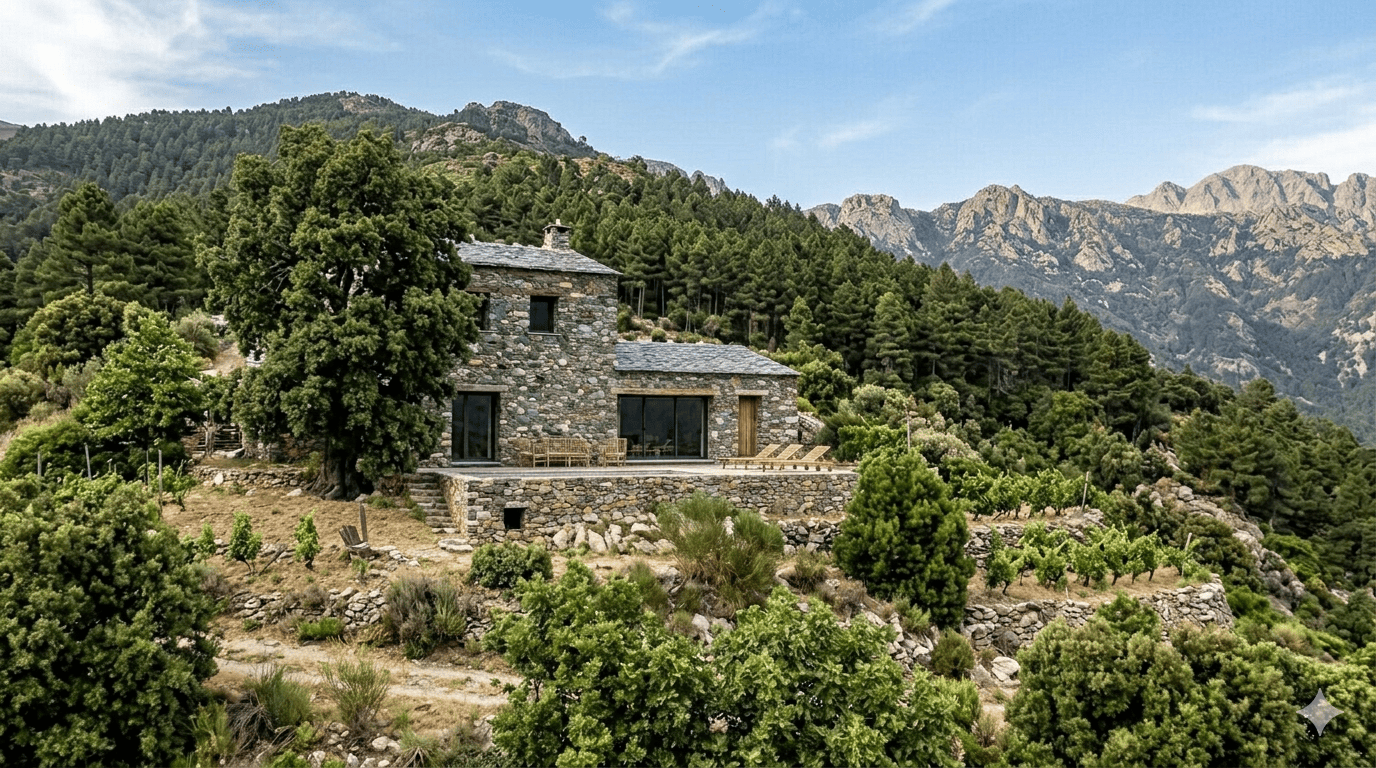
Corsican traditional architecture is among the most authentically sustainable in the Mediterranean basin. The stone houses in the inland villages - built in granite or local schist depending on the regions, covered with teghje (slates) or canal tiles, with a carefully adapted orientation to the relief and winds - have been integrating for centuries principles that contemporary science now calls bioclimatism. Thick walls offering high thermal inertia, small openings protected from prevailing winds, terraces shaded by trellises or chestnut trees: this architectural vocabulary precisely meets the climatic constraints of the island.
The challenge lies in the valorization of this heritage. A significant part of Corsican rural buildings is in a state of deferred rehabilitation, a consequence of a 20th-century demographic exodus that long immobilized the island's interior. Restoration operations carried out in respect of traditional materials - dry stone, lime, chestnut wood, earth - produce remarkable properties combining heritage value and real energy performance. The principles intersect with those described in our article on Heritage real estate: rehabilitating existing buildings is in itself a major ecological approach, avoiding land consumption and preserving the carbon footprint of an already constructed building.
The Saint-François Convent, a Reference for Contemporary Corsican Architecture
In recent years, sustainable Corsican architecture has gained international visibility thanks to the work of Amelia Tavella, an architect of Corsican origin whose rehabilitation of the Saint-François Convent in Sainte-Lucie-de-Tallano was distinguished by the 2026 Global Award for Sustainable Architecture. This project embodies an approach that goes beyond mere energy performance: listening to a place, understanding its history and materials, and intervening with restraint to reveal the existing building rather than replace it.
This architectural philosophy increasingly permeates contemporary Corsican projects, both in residential and hospitality sectors. For buyers sensitive to the cultural and heritage dimension of an investment, Corsica offers a rare coherence between location, history, materials, and ecological approach.
The Premium and Concentrated Southern Market
Southern Corsica - Bonifacio, Porto-Vecchio, Cap Corse - concentrates most of the island's high-end real estate offerings, and therefore a significant part of sustainable properties. Bioclimatic new villas are being developed around several principles: local materials (granite, chestnut), extensive rainwater harvesting, meticulous landscaping with endemic Mediterranean species, integrated rooftop solar panels.
The entry price for a bioclimatic new villa in southern Corsica generally ranges from 1.5 to 4 million euros for 200 to 350 m², with prices soaring beyond on the most exclusive locations - seaside properties in Bonifacio, vineyard estates in Porto-Vecchio. This clientele, largely international (mainland French, Italian, Swiss, British), is particularly attentive to sustainability standards and notably to water autonomy, a central issue on an island subject to recurring summer restrictions.
Cap Corse and the Interior, Segments to Discover
Beyond the touristic south, two segments deserve buyers' attention seeking authenticity.
The Cap Corse, a wild peninsula in the north of the island, offers remarkable built heritage - Americans' houses, restored Genoese towers, perched villages - at prices significantly more accessible than the south. The sustainable renovation of a Cap stone house, preserving the original architectural elements and integrating contemporary energy standards, represents a project with strong heritage value. Expect between 400,000 € and 1.5 million € for properties of 150 to 250 m² depending on the municipality.
The mountainous interior - Niolu, Castagniccia, Alta Rocca - constitutes the most confidential and financially accessible segment. Traditional stone houses can be found starting from 200,000 € for properties to renovate, up to 800,000 € for completed exemplary restorations. It is a market for buyers seeking tranquility, exceptional natural settings, and heritage commitment - less liquid than the south but remarkably coherent for an authentic primary or secondary residence project.
Autonomy, An Insular Imperative
The insularity of Corsica makes water and energy autonomy particularly valuable. The island's electrical network partially depends on submarine cable importation, and energy tension episodes in the summer are recurrent. Similarly, the water resource, although generally abundant due to the relief, is subject to regular restrictions in the most touristic areas during summer.
For real estate properties, these constraints translate into increased valuation of electricity autonomy devices - integrated solar panels, domestic batteries, domestic wind turbines in exposed areas - and water autonomy - large rainwater recoverers, drilling, greywater management. These equipments, still considered as an addition on the mainland, become an expected standard for high-end Corsican properties.
Truly exemplary properties combine these two autonomies with advanced bioclimatic design - sometimes approaching the standard detailed in our passive house guide, adapted to the insular Mediterranean climate. This category remains a minority but grows steadily, supported by demanding clientele and by a new generation of Corsican architects trained in contemporary standards.
Taxation and Investment Mechanisms
Real estate investment in Corsica benefits from several specific tax schemes, in addition to national mechanisms applicable throughout the territory.
For heritage properties located in classified historical centers - notably Bastia, Ajaccio, Bonifacio, Calvi - the Malraux Law allows finance a part of restoration works through a tax reduction of up to 30% of the incurred expenses. Eligibility depends on the precise zone (PSMV or PVAP) and must be validated with municipal urban planning services and the Architects of Buildings of France.
The Jeanbrun scheme also applies in Corsica, without geographical limitation, allowing rental investors to depreciate up to 80% of the value of a new or old housing over nine years. The Corsican rental market, marked by strong seasonality, can be particularly suitable for this scheme for buyers willing to rent as a primary residence rather than as a tourist rental.
Finding a Sustainable Property in Corsica
Sustainable Real Estate showcases sustainable real estate properties throughout the Corsican territory, from the premium south to the confidential villages of the interior. The Corsica page brings together the regional selection, filterable by location, sustainable criteria, and property type. For the most emblematic heritage properties - restored village houses, vineyard estates, exceptional rural properties - the Heritage section extends the selection with a reinforced heritage dimension.
Sustainable Real Estate selects sustainable real estate properties throughout France. Discover the Corsican selection on the Corsica page and the 7 sustainable criteria applied to each property.