Bassin d'Arcachon: sustainable real estate facing the coast
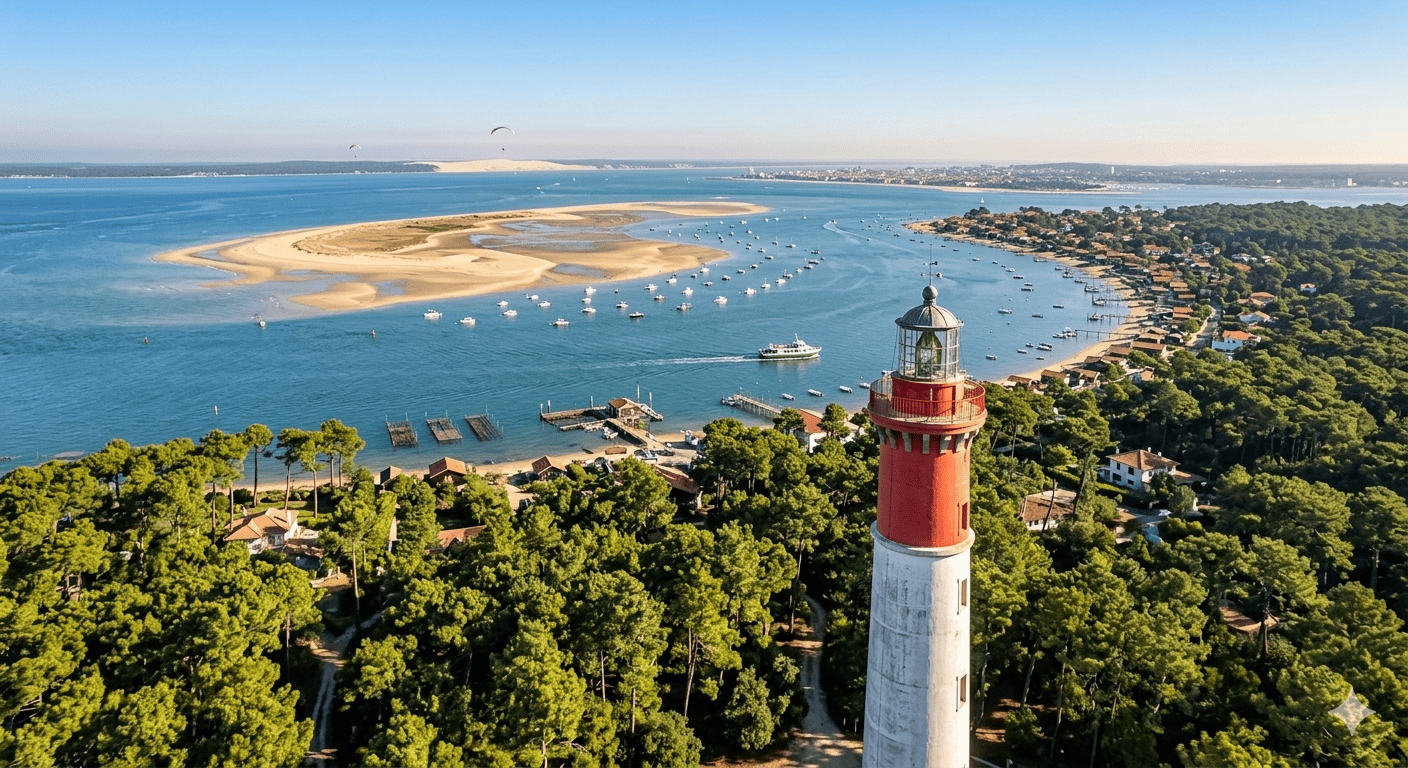
Forty square kilometers of inland water, seventy-seven kilometers of coastline, exceptional biodiversity, and unabated real estate pressure. The Bassin d'Arcachon is one of the French territories where the tension between residential attractiveness and environmental preservation is most strongly felt. This equation makes the question of sustainable real estate particularly central, at a time when the climate calendar is tightening and coastal erosion is becoming a visible reality. Here is an overview of the sustainable real estate market in Arcachon for 2026.
A territory under environmental tension
The Bassin d'Arcachon presents an ecological vulnerability that makes it both a case study and a testing ground for sustainable real estate. The biodiversity there is exceptional: seagrass beds, salt meadows, wooded dunes, maritime pine forests. But this ecosystem is under increasing pressure - coastal urbanization, sometimes fragile water quality in the basin, accelerated erosion of the Pilat dune and Cap Ferret, rising sea levels threatening the lowest-lying areas by 2050.
For buyers, these environmental challenges are gradually becoming criteria for real estate assessment. A property located in a risk zone (erosion, marine submersion) will see its value evolve differently from a property inland or at a higher relative altitude. Insurance companies are beginning to incorporate these risks into their pricing grids. In this context, sustainable practices no longer only belong to ecological commitment: they become an element of heritage strategy.
Arcachon architecture, a heritage to be valued
The Bassin d'Arcachon has a unique architectural heritage, structured around several highly identifiable typologies.
The 19th-century Arcachon villa, created during the development of the winter town, presents an eclectic architecture blending Anglo-Norman, Italian, and Moorish influences. These villas built of stone, wood, and bricks are now prestigious properties, often classified or listed. Their restoration, when carried out with rigor, now integrates contemporary energy standards while rigorously respecting the architectural identity. For properties located in protected areas, schemes like the Malraux Law can support restoration operations.
The oyster-farming shack and the stilted tchanquée hut, emblematic of the Bassin, have seen their status evolve in recent years. Originally modest, these constructions on stilts or at the edge of the basin have become sought-after properties, sometimes transformed into residences. The sustainable renovation of a shack requires rigorous respect for the vernacular character - wooden structure, simplicity of volumes, landscape integration - while improving insulation and thermal comfort.
The contemporary bioclimatic villa has more recently emerged, driven by a new generation of architects established in Cap Ferret, Pyla-sur-Mer, or Arès. Wooden frames, large bay windows facing the basin, vegetated or photovoltaic roofs, careful landscape integration with the preservation of existing maritime pines: these villas reinterpret the Arcachon imagery with contemporary sustainable construction standards.
Cap Ferret, prestige and commitment
The Cap Ferret peninsula concentrates a significant portion of the upscale properties in the Bassin, and thus a particularly developed sustainable offer. The municipalities of Lège-Cap-Ferret, Canon, Herbe, or Jacquets host new bioclimatic villas whose standards rival the best Mediterranean achievements. Wooden structures, insulation with biobased materials, partial electricity autonomy via integrated solar panels, systematic rainwater recovery.
The market is tight, and entry prices are high. Count starting from 1.8 million euros for a new bioclimatic villa of 180 m² in secondary municipalities, and up to 8 or 10 million euros for exceptional properties on the immediate edge of the basin. This clientele, mainly from Bordeaux and Paris, is paying increasing attention to sustainable criteria - energy efficiency, landscape integration, quality of materials - in addition to the classic criteria of location and amenities.
Pyla-sur-Mer and the southern coast, heritage segment
To the south of the Bassin, Pyla-sur-Mer offers a mix of historic villas and more recent constructions. The villas from the early 20th century, built at the foot of the Pilat dune, constitute an exceptional architectural heritage but are subject to specific constraints related to dune erosion and geological stability. Several emblematic villas have been moved in recent years due to the advancement of the dune.
For buyers interested in this segment, two logics coexist. The first is to acquire a historic villa to be restored, integrating substantial energy performance improvements into the work - breathable interior insulation, window replacements, ecological heating. The second is to invest in a new construction on the preserved heights, respecting the Local Urban Plan that strictly regulates buildability in this area. Prices generally range from 2 to 6 million euros for a 200 to 350 m² villa depending on the location and condition.
Arès, Andernos, Lanton: the more accessible northern basin
To the north of the Bassin, the municipalities of Arès, Andernos-les-Bains, Lanton, and Audenge offer a more financially accessible alternative, with a growing sustainable real estate market. New bioclimatic villas start from 700,000 euros for 150 m², with amenities comparable to those in the southern Bassin but in less prestigious locations. This segment is particularly interesting for buyers residing year-round - teleworking professionals, urban retirees - looking for a sustainable living environment without the entry ticket of Cap Ferret or Pyla.
The market is also more liquid, with a higher volume of transactions and properties available across a wider range. For rental investors, these municipalities can be part of the Jeanbrun scheme with an annual rental return generally higher than in southern municipalities.
The challenge of water and marine submersion
In a territory whose identity is based on the maritime basin itself, water management takes on both an ecological and heritage dimension. The quality of the Bassin's waters, essential for shellfish farming and biodiversity, depends directly on residential practices - wastewater treatment, stormwater management, choice of environmentally friendly household products. For real estate properties, the installation of a performant individual sanitation system, when the property is not connected to the collective network, becomes a major qualifying criterion.
Rainwater recovery, already common in new bioclimatic villas, is gradually extending to exemplary renovations. Arcachon gardens, traditionally composed of maritime pines and local shrub vegetation, require little watering when preserved in their original composition - but much more when transformed into lawns and exotic plantations.
The issue of marine submersion represents a more distant but real horizon. The lowest-lying areas of the Bassin (some areas of Arcachon, Teich, Biganos) will gradually be exposed to increased risks by 2050-2100. For buyers with long-term heritage projects, this dimension deserves to be integrated into location analysis.
Finding a sustainable property in the Bassin d'Arcachon
Sustainable Real Estate offers references to sustainable properties throughout the entire Bassin d'Arcachon, from premium Cap Ferret to more accessible northern municipalities. The Bassin d'Arcachon page brings together the regional selection, filterable by location, sustainable criterion, and property type.
For the most emblematic heritage properties - restored historic Arcachon villas, transformed shacks, exceptional properties on the edge of the basin - the Heritage section extends the selection with a reinforced heritage dimension. The coherence between sustainability and heritage is particularly strong in this area, where environmental preservation and architectural valorization naturally converge.
Sustainable Real Estate selects sustainable properties throughout France. Discover the Arcachon selection on the Bassin d'Arcachon page and the 7 sustainable criteria applied to each property.