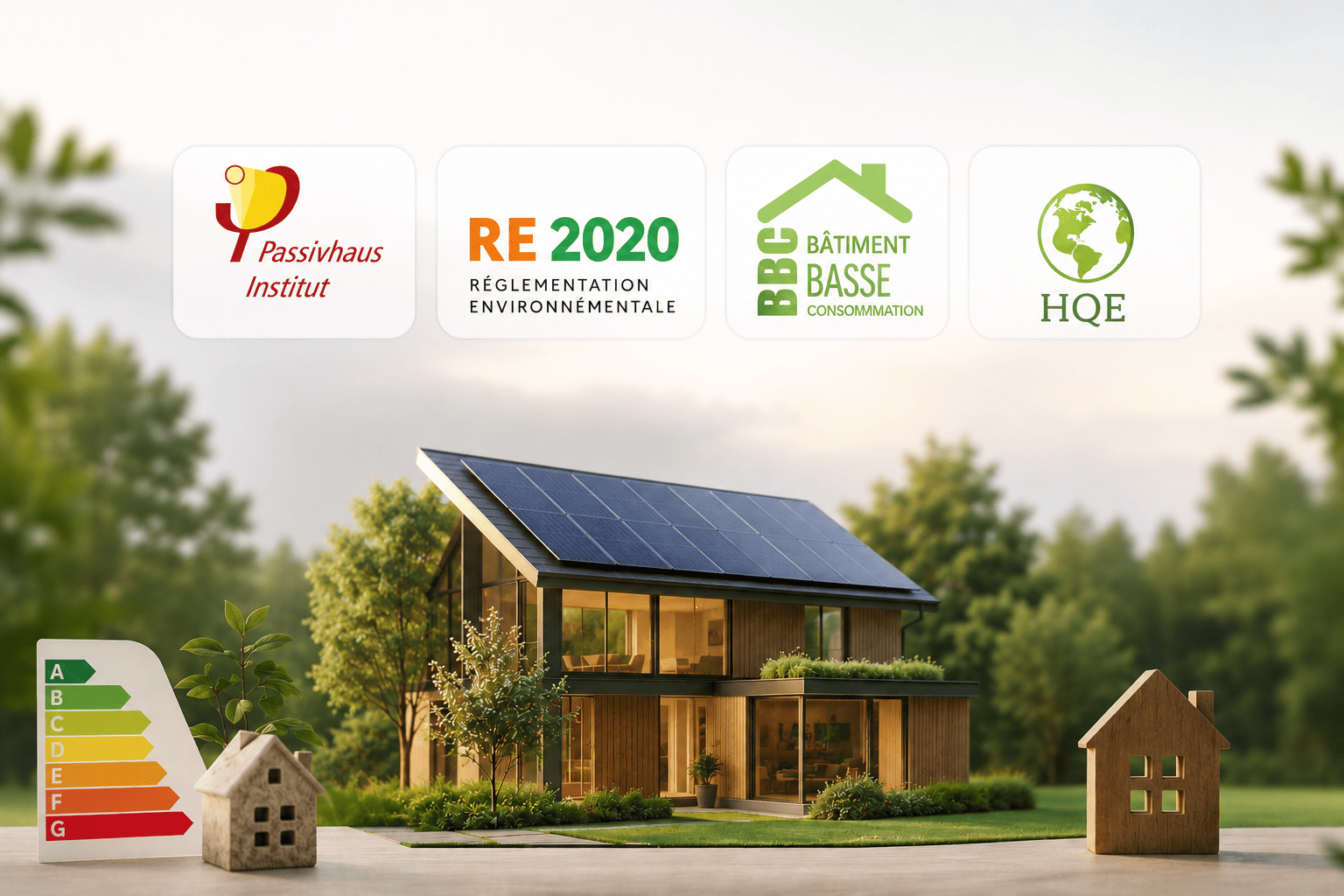
Passivhaus, RE 2020, BBC, HQE: comparison of sustainable real estate labels
The French sustainable real estate market is multiplying labels, certifications, and standards to the point where it can sometimes be difficult to navigate. What are the differences between a BBC certified house and a Passivhaus house? Is the RE 2020 a mandatory certification or standard? Does HQE guarantee specific performances? This guide provides an overview of the main current references in 2026, their respective requirements, and their relevance according to the type of project.
Differentiating mandatory standards and voluntary certifications
A first structuring distinction is essential before any detailed examination. The standards that govern sustainable real estate are divided into two broad categories with very different logics.
Mandatory regulatory standards apply to all new constructions in French territory. They set a minimum performance threshold that every building must achieve to be delivered and certified compliant. This is the case, for instance, with the RE 2020, applicable to all new constructions since January 2022.
Voluntary certifications are additional quality processes that the owner chooses to target, generally to enhance a property in the market or to achieve a higher level of performance. Passivhaus, HQE, EnerPHit, BBCA (Low Carbon Building) belong to this category. They impose stricter requirements than mandatory standards and lead to certification issued by an independent organization.
This distinction is essential to understand the real value of a property in the market. A property compliant with RE 2020 meets the current minimum requirements - it is now the new standard, not a distinctive argument. A Passivhaus certified property goes beyond - it is a strong differentiating argument justifying market valuation.
The RE 2020, national standard for new buildings
The 2020 Environmental Regulation (RE 2020) is the regulatory framework for new constructions in France since January 1, 2022. As detailed in our dedicated article on RE 2020, it replaces the previous RT 2012 by significantly broadening the evaluation scope.
The RE 2020 is built around three pillars: energy performance (limited primary energy consumption), carbon footprint over the building's life cycle (extraction, construction, use, deconstruction), and summer comfort in the face of climate change (limiting hours of thermal discomfort in hot periods). It is this integration of carbon and summer comfort that distinguishes the RE 2020 from the RT 2012, which was more restrictively focused on energy consumption during use.
The requirements of the RE 2020 are progressively strengthened in stages in 2025, 2028, and 2031, with a regular tightening of carbon thresholds. Ultimately, the standard will require the use of bio-based materials and almost exclude conventional concrete from standard residential constructions. It is one of the most ambitious environmental regulations in the world in its sector.
A property compliant with RE 2020 generally achieves a DPE A or B and benefits from a reduced carbon footprint compared to previous constructions. However, as it is now the new standard for new buildings, it is no longer a distinctive argument in itself - except when compared with old properties or illegally non-compliant constructions.
The BBC label, a still present legacy
The Low Consumption Building (BBC) label, created in 2007 by the Effinergie association, was one of the first French references to promote energy performance beyond the regulatory minima of the time. It required a primary energy consumption below 50 kWh/m²/year for heating, hot water, ventilation, lighting, and auxiliaries.
The BBC label significantly structured the new construction market between 2007 and 2022, before being gradually integrated into successive regulatory requirements (RT 2012 then RE 2020). Today, the BBC label is no longer issued for new constructions, which automatically meet at least the BBC level by complying with RE 2020.
However, the Effinergie label continues to exist in various variants - Effinergie+, Effinergie BEPOS (Positive Energy Building) - which aim for higher performance levels than RE 2020. These labels remain relevant for ambitious projects wishing to go beyond regulatory requirements.
For existing properties marketed with the BBC mention, this means that they were built or renovated at a time when this label represented the state of the art - generally between 2007 and 2022. The performance remains acceptable today but no longer systematically exceeds current standards.
The Passivhaus label, maximum requirement
The Passivhaus label, created in Germany in 1991 by the physicist Wolfgang Feist, is the international reference for passive buildings. Its technical requirements are among the strictest in the world, making it a significant differentiating argument in the real estate market.
For a building to be Passivhaus certified, it must meet three measurable criteria: primary energy consumption below 15 kWh/m²/year for heating, air permeability measured at n50 ≤ 0.6 vol/h, and total primary energy consumption below 120 kWh/m²/year. Our complete guide to passive houses details the technical principles and certification conditions.
The EnerPHit label is the Passivhaus variant applied to the renovation of old buildings. The requirements are slightly relaxed (25 kWh/m²/year for heating instead of 15) due to the structural constraints of renovation but remain considerably stricter than usual standards. It is the reference label for the most ambitious renovations, particularly suited for Parisian renovations or demanding chalet renovations.
Passivhaus or EnerPHit certification requires an additional investment of 10 to 20% compared to a construction compliant with the standard RE 2020 but offers energy consumption 50 to 75% lower in the long term. For a buyer wishing to maximize the asset value and real performance of their property, this is currently the most solid differentiating argument available.
The HQE, multicriteria quality approach
The High Environmental Quality (HQE) is a French approach created in 1996, which offers a multicriteria approach to sustainable building rather than strict numerical requirements. It evaluates 14 targets grouped into four categories: eco-construction, eco-management, comfort, and health.
Unlike Passivhaus, which focuses mainly on energy performance, HQE integrates broader dimensions: indoor air quality, water management, choice of materials, visual and acoustic comfort, integration into the site. This multicriteria approach appeals to some project developers who want a comprehensive approach rather than an energy focus.
HQE is particularly used for collective operations (buildings, public facilities) and remains a minority in individual residential properties. For buyers interested in a collective new program presented as HQE, it is essential to verify the level of certification achieved (HQE, HQE Excellent, HQE Exceptional), which determines the actual level of requirement.
Other relevant complementary certifications
Several other labels and initiatives deserve to be mentioned to complete this overview.
The Low Carbon Building (BBCA) label, created by the association of the same name, specifically values the building's carbon performance over its life cycle. It naturally complements RE 2020 for operations wishing to go further on the carbon footprint dimension.
The E+C- (Positive Energy and Carbon Reduction) label constituted the preparatory experimentation for RE 2020 and is still used for a few very demanding pilot operations aiming for a positive energy balance.
The Biosourced Building label specifically certifies the significant use of biosourced materials in construction, with three levels according to the quantity used. It is a discreet but relevant label for buyers sensitive to the material dimension.
The international BREEAM certification, mainly adapted to the tertiary sector, remains largely unused in the French residential market. For buyers interested in this dimension, our article on BREEAM certification details the principles and scope of application.
Which label to choose for which project
The choice of the relevant label depends essentially on the project and the objectives pursued by the buyer or the owner.
For a new construction, RE 2020 is mandatory. Beyond that, aiming for a Passivhaus certification represents the most powerful differentiating argument for market valuation, particularly suitable for ambitious constructions in tourist or heritage regions (Côte d'Azur, Bassin d'Arcachon, Provence). For buyers looking for a multicriteria approach, HQE may be more relevant.
For a renovation, the EnerPHit label is the ultimate goal but requires significant resources and a compatible structure. For the vast majority of renovations, aiming for a DPE A or B (compatible with BBC renovation requirements) without formal certification remains a relevant choice that significantly enhances the property.
For an investment property, the choice depends on the local market and the target clientele. In a premium market (Cap Ferret, Cannes, Megève), a Passivhaus or EnerPHit certification is a strong argument. In a more standard market, aiming for a DPE A or B is generally sufficient.
For heritage properties falling under the Heritage section, coherence with traditional materials and techniques often takes precedence over the pursuit of the most demanding certifications. A renovation respectful of the original architectural character, achieving a DPE B or C, may be more valuable than a Passivhaus renovation that would sacrifice the heritage authenticity of the property.
How Sustainable Real Estate integrates these labels
Instead of aligning with a specific label, Sustainable Real Estate has developed its own seven sustainable criteria framework, which aggregates the essential dimensions of existing labels by adapting them to the specificities of the French residential real estate. The "Energy Efficiency" criterion integrates the requirements of DPE, BBC, and Passivhaus according to the level achieved. The criteria "Water Self-sufficiency," "Electricity Self-sufficiency," and "Ecological Heating" extend the evaluation beyond simple energy performance. The "Durable Materials" criterion includes the biosourced dimension and the heritage nature. The "Mobility" criterion assesses accessibility by public transport. The "Recycling" criterion covers water and waste management.
This multicriteria approach allows evaluating each property on its own merits, without reducing it to a single indicator. The full details are available on the Our commitment page.
Find a property that matches your level of requirement
Sustainable Real Estate references real estate properties that meet various levels of sustainable requirements, from recent RE 2020 standard to Passivhaus certified constructions. The selection to buy covers all available typologies, filterable by the seven sustainable criteria to identify properties corresponding to the specific level of requirement sought.
For exceptional heritage properties, whose specific characteristics justify different approaches from standardized labels, the Heritage section extends the selection with reinforced architectural and cultural dimensions.
Sustainable Real Estate selects sustainable real estate properties throughout France. Discover the selection on Sustainable Real Estate and the 7 sustainable criteria applied to each property.