
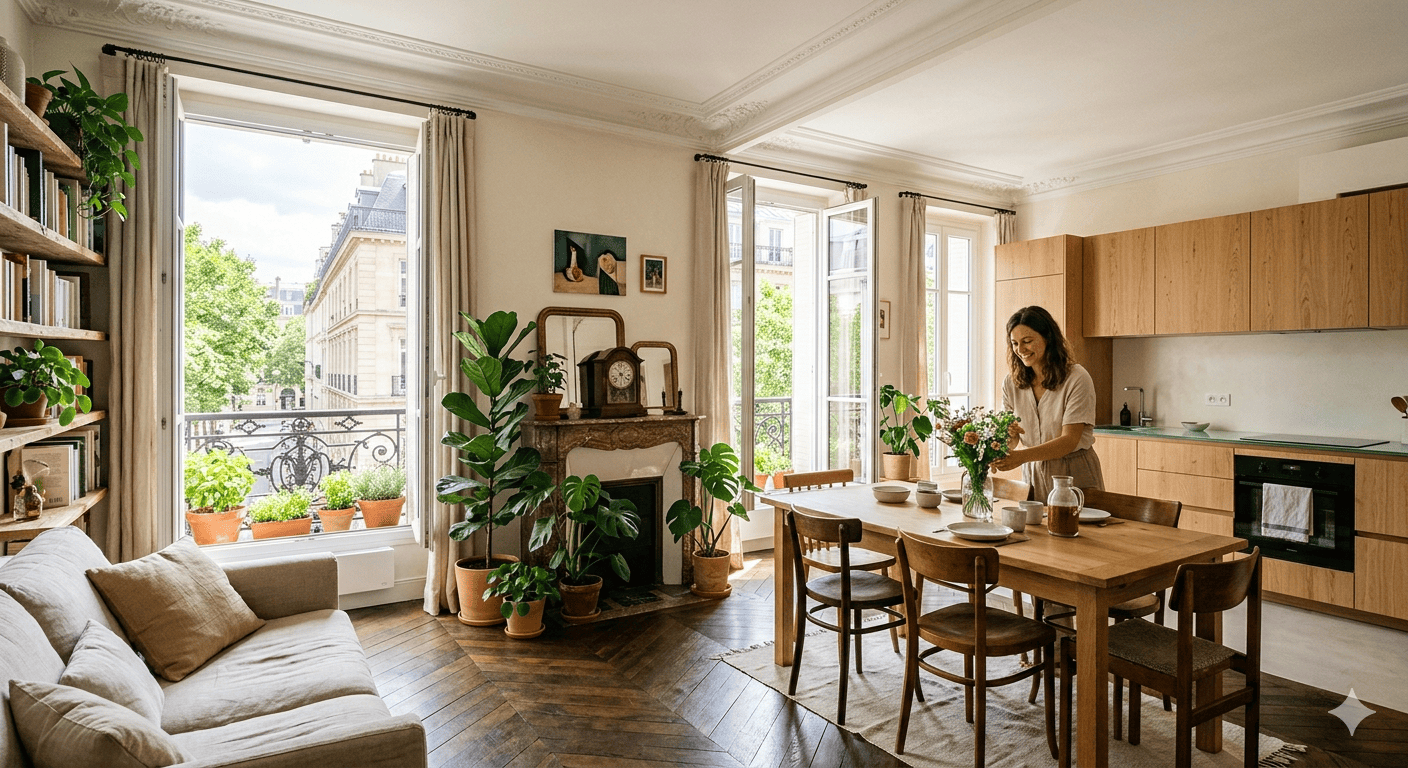
Renovating a Parisian Apartment into Sustainable Housing: Practical Guide
The Parisian real estate market is made up of over 80% of buildings constructed before 1948. Haussmann-style, suburban, Art Deco, or from the 1930s - each building has its own character, but also its limitations in terms of energy performance. With the combined impact of the Climate and Resilience Law, rising energy costs, and the value placed on the Energy Performance Certificate (DPE), sustainable renovation has become a major issue for Parisian property owners. Here's what you need to know before getting started.
Why Renovate a Parisian Apartment in 2026
Three factors converge to make renovation essential.
The regulatory timetable. The Climate and Resilience Law sets a schedule for the progressive prohibition of renting energy-intensive housing: G by 2025, F by 2028, E by 2034. In Paris, where 30% of the housing stock is classified as E, F, or G, the challenge is massive for property landlords.
Heritage value. A Parisian property classified with a DPE A or B sells on average 8 to 12% higher than an equivalent property classified as D, and up to 20% more than an F or G property. In the case of an 800,000€ Parisian apartment, the difference in value represents 60,000 to 160,000€.
Comfort of use. Beyond the DPE and tax considerations, a well-executed renovation transforms the living experience: elimination of thermal bridges, improved soundproofing, air quality, coolness in summer. Aspects that are hard to monetize but crucial in daily life.
The Technical Elements of a Sustainable Renovation
Renovating a Parisian apartment relies on various complementary elements to be activated according to the building type and budget.
Thermal insulation. This is the most impactful area. In a condominium apartment, exterior insulation depends on a vote in the general assembly. Alternatively, interior insulation is possible, quicker to implement but with a loss of living space (5 to 10 cm per wall). Bio-based materials like wood fiber, cellulose wadding, or hemp are preferred for their low carbon footprint and hygrothermal properties suitable for old buildings.
Windows. Upgrading to high-performance double glazing - or even triple glazing - significantly reduces heat loss and improves acoustics, critical in busy Parisian streets. Average cost: 600 to 1,200€ per window depending on size and quality.
Ventilation. In a well-insulated housing, ventilation becomes crucial for air quality and comfort. A single-flow hygroregulated Mechanical Controlled Ventilation (MCV) is the minimum; a double-flow MCV with heat recovery is the standard to achieve the best energy performance.
Heating. Replacing an energy-intensive individual heating system with an efficient solution (air-water heat pump, pellet boiler, connection to the urban heating network) can reduce the bill by 40 to 70%. Note: In a condominium equipped with collective heating, the decision lies with the general assembly, not the individual co-owner.
Specificities of Parisian Buildings to Know
Not all Parisian apartments are renovated in the same way. Some specificities shape the technical choices.
Haussmannian buildings. Stone walls, generous ceiling heights (3 to 4 m), herringbone parquet, moldings, fireplaces. These elements require trade-offs: ITE is rarely authorized because it alters the facade, ITI must be carried out with breathable materials to preserve the hygrothermal regulation of stone walls. The old windows can be preserved by internal doubling rather than replaced, to maintain the aesthetic.
Suburban buildings. Easier to renovate than Haussmannian, these buildings from the 1850s to 1920s generally support ITI and window replacements well. The more modest volumes facilitate energy return on investment.
Buildings from the 1950s-1970s. Concrete construction, often lacking original insulation. Very significant energy improvement potential but requires heavy intervention. ITE is often feasible and particularly effective on this type of building.
Buildings before 1850. Often with rubble walls, more humid. Renovations must absolutely use breathable materials (lime, wood fiber) to avoid disorders related to humidity. This is the type of building that requires the most precautions.
For properties located in protected areas, schemes such as the Malraux Law can help finance part of the restoration work through tax benefits.
How Much Does a Complete Parisian Renovation Cost ?
The cost of a sustainable renovation of a Parisian apartment varies considerably depending on the extent of the work. Here are some indicative ranges for 2026:
Light Renovation (paint, floors, bathrooms) - 400 to 800€ per square meter. Low energy impact.
Medium Renovation with insulation and windows - 1,200 to 2,000€ per square meter. Can achieve a DPE improvement of 1 to 2 classes.
Complete BBC-Level Renovation (insulation, windows, ventilation, heating) - 1,800 to 2,800€ per square meter. Can achieve a DPE A or B for a well-structured old apartment.
EnerPHit Standard Renovation (equivalent to a passive house in renovation) - 2,500 to 3,800€ per square meter. The most demanding level, achievable only on certain structures and with high technical constraints.
For a 70 m² Parisian apartment, a complete BBC-level renovation represents an investment of 125,000 to 200,000€. A significant investment but to be weighed against the property's value enhancement and energy savings over 20 years.
Available Assistance for Parisian Renovations in 2026
Several schemes can reduce the cost of a sustainable Parisian renovation.
MaPrimeRénov'. National aid calculated according to income and the energy gain from the work. Can reach 70% of the amount for low-income households, 40% for intermediate households.
MaPrimeRénov' Copropriétés. Specific to work in co-ownership, finances collective operations (facade insulation, replacement of collective heating).
Éco-PTZ. Interest-free loan up to 50,000€ to finance a package of energy renovation works. Cumulative with other aids.
Local Parisian Assistance. The City of Paris and the Greater Paris Metropolitan Area offer additional subsidies through the Parisian Climate Agency, including a 5,000€ "audit voucher" for co-ownerships engaged in a Global Technical Diagnostic approach.
Energy Saving Certificates (CEE). Aids provided by energy suppliers, usually included in the quotes of qualified RGE craftsmen.
The combination of these aids can cover 30 to 60% of the cost of an ambitious energy renovation for an average Parisian household.
Where to Find Already Renovated Parisian Apartments
For buyers who prefer to acquire a property already renovated rather than carrying out the works themselves, the offer exists and is growing. Sustainable Real Estate references renovated Parisian apartments according to sustainable real estate standards, with guaranteed A, B, or C DPE ratings. Properties can be filtered by location, services, and sustainable criteria.
The selection covers all districts of Paris and includes both meticulously renovated Haussmann-style properties (potentially eligible for tax schemes like the Malraux Law) and more contemporary apartments transformed into high-energy performance housing.
Sustainable Real Estate selects sustainable properties throughout France. Explore the Parisian selection on the Paris page and discover the 7 sustainable criteria applied to each property.