Sustainable Real Estate in Paris and Île-de-France: 2026 Overview
Île-de-France alone represents nearly 20% of the French real estate market and most of the energy renovation projects in the country. Due to the combined effects of the Climate and Resilience Law, the transformation of urban wastelands into eco-districts, and changing buyer expectations, sustainable real estate in this region is experiencing sustained growth. Here is a 2026 panorama of the market in the Paris region, the ongoing dynamics, and the properties to favor.
A Real Estate Market Dominated by Older Buildings
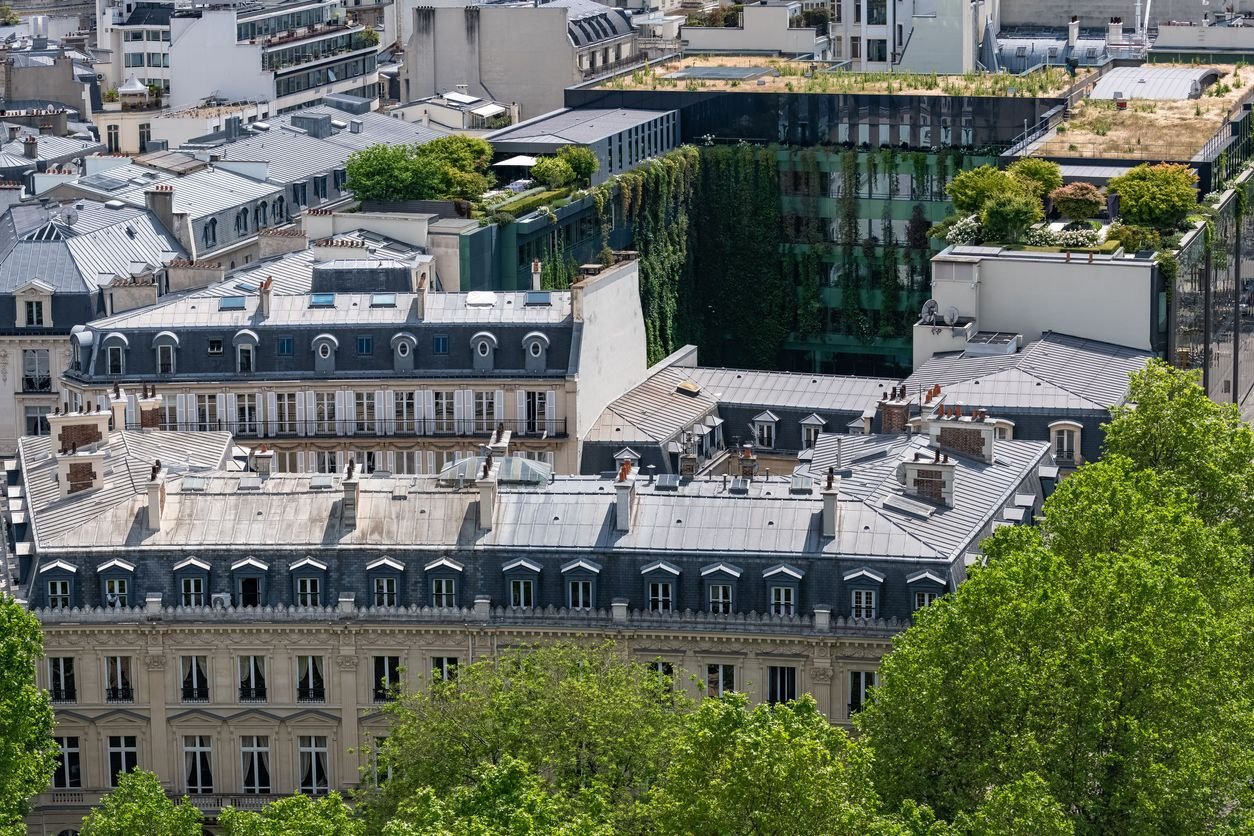
Paris and Île-de-France stand out from the rest of France due to the predominance of their old buildings. Central Paris has over 80% of housing built before 1948, and the entire region is marked by constructions from the 1950s to 1970s, often energy-intensive. This structure of the real estate makes energy transition more complex than elsewhere: large-scale new construction solutions are rare, and the focus is on extensive renovations.
This directly impacts the market: properties with high energy performance grades (DPE) are rare and valued. An apartment in Paris with a grade A or B sells on average 8 to 12% more than an equivalent property graded D, according to recent notarial data. The scarcity of such properties in Île-de-France creates a lasting premium.
Île-de-France Eco-Districts, Showcases of New Builds
To meet the demand for efficient housing, Île-de-France has multiplied eco-district development operations over the past decade. Boulogne-Billancourt, with its Rives de Seine, is one of the most advanced projects: the conversion of former industrial wastelands into a high-energy performance mixed-use neighborhood, incorporating natural ventilation, rainwater management, and soft mobility.
Similar operations are underway or completed in Issy-les-Moulineaux (Bords de Seine district), Pantin (Quatre Chemins), Nanterre (Coeur de Quartier), Versailles (Camp des Matelots), and Saint-Ouen (Docks). These eco-districts represent the majority of new properties RE 2020 available in Île-de-France today. They target both buyers looking to occupy efficient housing and investors interested in schemes like the Jeanbrun scheme.
Renovation of Old Buildings: a Major Challenge
In Paris and the inner suburbs, where new construction is marginal, energy transition almost exclusively goes through renovation. Three main levers drive the market.
Energy renovation in condominiums. The Climate and Resilience Law now requires condo associations to have a multi-year work plan. In Paris, where condominiums are predominant, this triggers a wave of renovations on roofs, façades, and collective heating systems.
Heritage rehabilitation. The historic neighborhoods of Paris (Marais, Île Saint-Louis, some parts of the 7th or 6th arrondissement) are classified as Remarkable Heritage Sites, granting access to the Malraux Law. Eligible buildings, sometimes rare but with high potential, interest investors seeking to combine tax benefits and heritage.
Transformation of individual homes. Suburban houses, private mansions, or family apartments undergo extensive renovations including external thermal insulation, dual-flow ventilation, and eco-friendly heating. The most advanced operations attain a level close to the passive house standard.
Mobility and Urban Planning: a Île-de-France Asset
Île-de-France benefits from a structural asset for the sustainability of its housing: its public transport network. The Grand Paris Express, currently being deployed, adds 200 km of metro and nearly 70 new stations by 2030, significantly altering the value of properties located nearby.
Sustainable mobility is one of the seven sustainable criteria applied to each property listed on Sustainable Real Estate. In Île-de-France, this criterion translates into proximity to a train station, a metro station, or a structured bus network. Properties located within 10 minutes of a key public transport see their appeal and value increase measurably.
Where to Look for Sustainable Properties in Île-de-France?
Sustainable real estate properties in Île-de-France concentrate on several complementary categories.
New eco-districts (Boulogne, Issy, Pantin, Nanterre, Saint-Ouen) offer high energy performance and guaranteed RE 2020 standards. Jeanbrun programs are multiplying for rental investors.
Renovated Parisian apartments in historic neighborhoods (Marais, Saint-Germain, Île Saint-Louis) combine heritage value and eligibility for Malraux in certain areas. The entry price is high, but their scarcity makes them resilient assets.
Renovated individual houses in the outer suburbs (Hauts-de-Seine, Yvelines, Val-de-Marne, Essonne) often represent the best compromise for buyers seeking efficient properties with generous space, at a better-controlled budget than in the city center.
Sustainable Real Estate lists sustainable properties covering these three segments, throughout Île-de-France. The Paris page and the Île-de-France page display a filtered selection by location and sustainable criteria.
Sustainable Real Estate is the leading French platform for ecological and sustainable real estate listings. Explore the selection in the Paris region on Sustainable Real Estate and discover the 7 sustainable criteria applied to each property.