
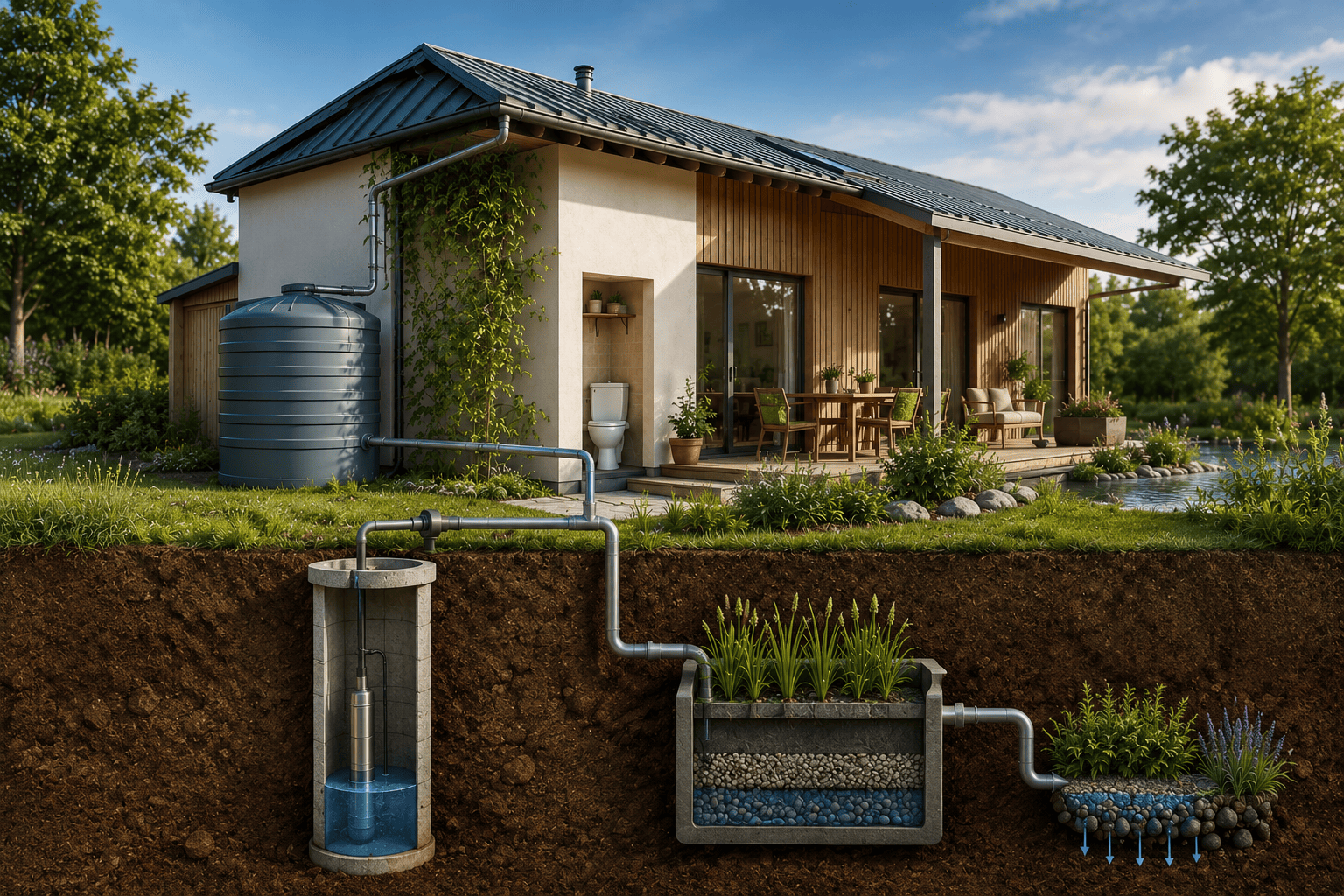
Water autonomy for a house: rainwater harvesting, drilling, greywater management
In France, water has long been considered an abundant resource, with availability not structurally questioned for residential properties. However, this perception is evolving. The repeated drought episodes since 2018, the recurring summer water restrictions even in traditionally well-supplied regions, and the growing awareness of the environmental cost of treating and delivering drinking water are leading an increasing number of buyers and property owners to integrate water autonomy into their real estate approach. This guide provides an overview of the available technical solutions, their costs in 2026, and the configurations suitable for different types of properties and regions.
Why Water Autonomy Is Becoming Strategic
Several factors are converging to transform water autonomy from an ecological option to a serious real estate criterion.
Structural water stress is worsening in mainland France. Groundwater recharge is less effective, rivers are experiencing more severe low flows, and residential usage restrictions (watering, pool filling, exterior cleaning) are becoming a summer reflex in many regions. The most exposed territories - Provence, Côte d'Azur, Corsica, Languedoc-Roussillon, as well as increasingly the West and Centre - are witnessing this trend as a long-term development.
The cost of water is steadily increasing. The average drinking water bill in France has risen by 30% since 2010, and this trend is expected to continue due to the necessary investments needed to adapt infrastructure, treat new pollutants, and manage increasing scarcity. Over a 20-year property ownership period, the investment in partial water autonomy becomes economically profitable, regardless of its ecological aspect.
Property valuation takes this aspect into account. Properties with genuine water autonomy are starting to benefit from a premium upon resale, particularly in high-end markets where international clientele (Anglo-Saxon, Swiss, Dutch) have been more aware of resource issues for a longer time. This discreet trend is expected to amplify in the coming years.
Rainwater Harvesting, First Step
Rainwater harvesting is the first, most accessible, and most profitable step towards residential water autonomy. The principle is simple: collect water running off the roof via gutters, store it in a reservoir, and use it for non-potable purposes - garden watering, toilet flushing, laundry, exterior cleaning, and even pool filling.
In mainland France, annual rainfall varies from 600 to 1,800 mm depending on the regions. For a 150-square-meter house with an equivalent roof area, the theoretical recovery potential ranges from 90 to 270 cubic meters per year. This resource far exceeds the needs for watering and internal non-potable uses of a typical family.
The reservoir's sizing is the central decision of any installation. A 5,000-liter tank suits limited use (garden watering only). A 10,000 to 15,000-liter tank covers watering and toilet flushing. A 20,000 to 30,000-liter tank allows extended use (laundry, cleaning, generous watering), particularly suitable for villas with extensive gardens.
The cost of a rainwater harvesting system varies by techniques. An above-ground 5,000-liter tank with basic installation costs between 1,500 and 3,000 euros. An underground tank of 10,000 to 20,000 liters with filtration, automatic pump, and connection to internal uses costs between 6,000 and 12,000 euros, including installation. For high-end villas with very comprehensive systems (UV filtration, automation, redundancy), expect 15,000 to 25,000 euros.
Since 2008, French regulations allow the use of rainwater for toilet flushing, washing laundry (with filtration conditions), and all external uses. Usage for human consumption remains prohibited in France, unlike in several neighboring countries.
Drilling: Superior but Regulated Autonomy
Drilling provides access to the water table for an independent water source from the public network. This solution offers significantly higher autonomy than rainwater harvesting but requires permits and presents specific constraints.
French regulations impose several obligations. Any drilling for residential use must be declared to the town hall at least one month before work commences. Municipalities can impose restrictions based on the local water table sensitivity, and certain areas (near drinking water catchments, groundwater protection zones) are prohibited from drilling. The use of extracted water is regulated: authorized for all non-potable uses without restriction, permitted for drinking water only after comprehensive health analyzes and the installation of a suitable treatment system.
The cost of drilling varies according to depth and the soil type. In mainland France, a residential drill generally reaches 30 to 80 meters deep, at a cost of 150 to 250 euros per meter drilled. Add the submersible pump, pressurization system, potential treatment system: the total budget typically ranges between 8,000 and 20,000 euros. The return on investment depends on the consumed water volume: for a standard family with a large garden and a pool, ROI can be achieved in 5 to 10 years depending on local water rates.
Drilling is particularly relevant in regions where rainfall is insufficient to meet needs through harvesting alone (southeast, south, certain parts of the Mediterranean hinterland), and in configurations with significant needs (large gardens, pools, livestock). For properties in regions with sufficient rainfall (Atlantic, Brittany, mountainous regions), harvesting alone may suffice to achieve good autonomy without the need for drilling.
Greywater Management: Advanced Stage
Greywater management represents the most advanced and still confidential stage of residential water autonomy. The principle involves recovering wastewater from showers, bathtubs, sinks, and washing machines ("greywater"), treating it, and reusing it for compatible purposes.
Several treatment levels coexist. Simple treatment through mechanical and biological filtration allows using greywater for garden irrigation or toilet flushing. Advanced treatment, including UV disinfection, enables broader uses but is reserved for sophisticated installations.
The cost of a greywater management system ranges from 8,000 to 25,000 euros depending on the level of sophistication. Strict economic profitability is more challenging to establish than for rainwater recovery, but the ecological benefit is significant: it is possible to reduce a household's drinking water consumption by 30 to 50% by combining rainwater recovery and greywater treatment.
For properties in regions with particularly scarce water resources (Corsica, Côte d'Azur, some parts of Provence), this aspect holds great value. Our article on eco-friendly construction in Corsica details how insularity makes this approach particularly valuable.
Landscape Design, Often Overlooked Lever
Beyond technical solutions, garden landscaping is a major water-saving lever often overlooked. A conventional garden with English lawn and exotic plantings can consume several hundred cubic meters of irrigation water per year - much more than the internal uses of a complete family.
Conversely, a garden composed of local species adapted to the regional climate requires minimal watering outside of the planting period. A Mediterranean garden with olive trees, lavender, rosemary, cistus, and mastic can thrive almost autonomously in Provence or the Côte d'Azur. An Atlantic garden with maritime pines, strawberry trees, heathers, and hydrangeas perfectly withstands the summers of the Arcachon Basin or Brittany.
This landscaping aspect is particularly significant for high-end properties with extensive gardens. A buyer or owner who invests in a high-performance water recovery system while maintaining a continuously watered English lawn is making the wrong choice: water savings begin with plant selection.
Mulching techniques, raised beds with water retention, programmed drip irrigation systems, and keylines (contour lines that slow runoff and promote infiltration) are valuable complements to water-efficient landscaping.
Recommended Configurations by Property Type
Several typical configurations emerge based on the property profile and region.
For a single-family house with a garden in a temperate region (Île-de-France, Pays de la Loire, Centre), rainwater harvesting of 10,000 to 15,000 liters combined with a water-efficient garden generally constitutes a sufficient setup. Total cost: 6,000 to 12,000 euros. Estimated coverage: 30 to 50% of non-potable water needs.
For a single-family house with a garden in the Mediterranean region (Provence, Côte d'Azur, Corsica), a combination of 20,000-liter rainwater harvesting + declared drilling + Mediterranean garden with drip irrigation represents the reference investment. Total cost: 15,000 to 30,000 euros. Estimated coverage: 70 to 90% of needs.
For a high-end villa with a pool and large garden, the generous recovery triptych (30,000 liters and more) + drilling + greywater management allows for nearly complete autonomy. Total cost: 30,000 to 60,000 euros. Estimated coverage: 85 to 98% of needs.
For an apartment or a condominium house, individual solutions are limited due to the collective nature of the property. Rainwater harvesting for a balcony or terrace remains feasible but on a modest scale. The main path for improvement lies in the collective decisions of the condominium, particularly regulated by the Climat et Résilience law.
Financial Assistance Available in 2026
Financial aids specifically dedicated to water autonomy are less developed than those focusing on energy performance, but a few programs exist.
Some local and regional authorities offer subsidies for rainwater harvesting systems or water-efficient irrigation installations. Water Agencies intervene in certain regions, particularly in water-stressed areas. The Provence-Alpes-Côte d'Azur region and Nouvelle-Aquitaine have specific programs.
The tax credit for energy transition has long supported rainwater recovery equipment, but this has been replaced by MaPrimeRénov', which does not cover water autonomy per se. The Eco-PTZ can finance these equipment within a comprehensive renovation project that includes major energy works.
For rental investors, water autonomy equipment can be amortized under the Jeanbrun device, by incorporating property valuation.
Finding a Water-Autonomous Property
Sustainable Real Estate specifically identifies properties with water autonomy through a dedicated label, one of the seven sustainability criteria applied to each referenced property. The Water Autonomy page gathers corresponding properties, filterable by location and type. The identified properties cover a wide range of configurations, from simple rainwater recovery to comprehensive systems integrating drilling, greywater management, and water-efficient landscaping.
For buyers interested in a comprehensive autonomy initiative - water and electricity - the Water Autonomy page and Electricity Autonomy page can be cross-referenced to identify properties combining both criteria. These properties, particularly valued in premium markets, are often featured in the Heritage section when their heritage dimension allows.
Sustainable Real Estate selects sustainable properties throughout France. Explore the selection on the Water Autonomy page and the 7 sustainable criteria applied to each property.